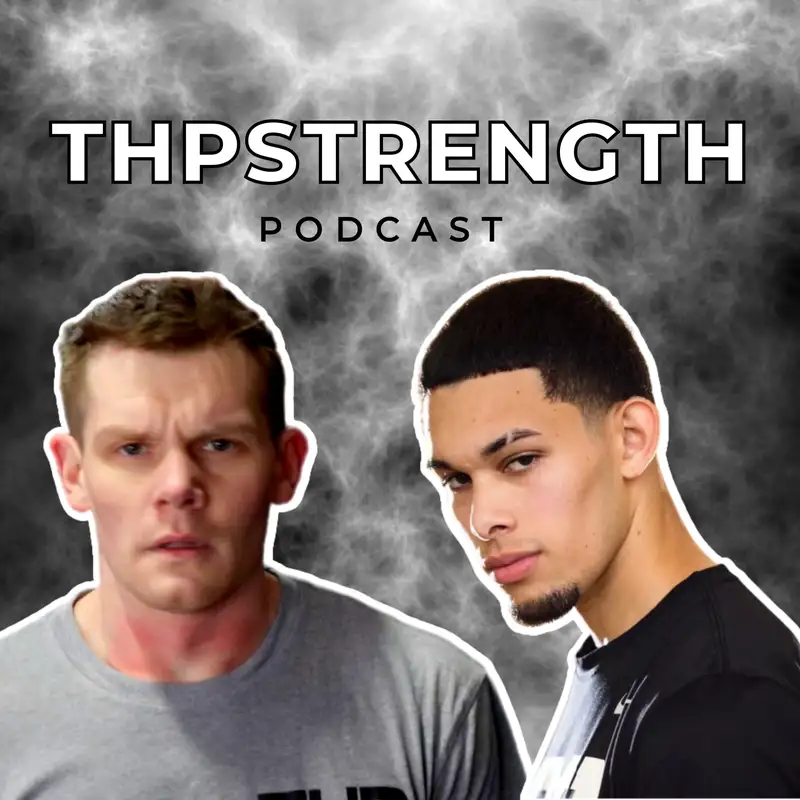
Training the GLUTES to jump higher and be more explosive
You know why I can jump 50.5 inches in the air? No. Look at these glutes. They are quite literally. You know, we were talking about hamstrings the other day and how they're not, they don't do that much for two foot jumping.
Isaiah:The glutes do a lot. On the other hand, big booty Isaiah. I was gonna say
John:big booty bitches, but it doesn't work. His glutes, I'll tell you what, they not only are they discussed on the Internet frequently, but they're also functional. They're not just for looks. Yeah. Okay?
Isaiah:You ever see me hip thrust? It's like 700 something.
John:I I actually watch it in slow motion every night. Purely for research purposes, though.
Isaiah:All all jokes aside, it is one of the most important muscles if you wanna jump higher. And today, we're gonna discuss their function, how to train them effectively, how we periodize them, how we fit them in a training plan so that you can use that information to hopefully jump higher, which is what we're trying to do here at the end of the day. Speaking of which, if you are an athlete that has trouble sleeping because you're staying up thinking about your jump technique, If you're an athlete that gets butterflies on Saturdays because it is jump day. Yeah. Yeah.
Isaiah:Go ahead. If you're an athlete Uh-huh. That likes training hard and being really tired because you know you're investing into jumping higher Yeah. Later on. Yeah.
Isaiah:If you're not an athlete No. It's not. That just saw one dunk video and you're gonna impulsively buy a jump program No. I watch them, man. And then stop doing the workouts a week in.
Isaiah:That's not you. Go to thpstrength.com and use the code THP for 10% off of your first month. I guarantee it'll be the best investment you have ever made in your career. And if you are that athlete, you will also acquire three friends who will be very invested in you and build a relationship with you and help you jump higher.
John:Shout out to the the guy on my call today. He's from he's from Hungary. He was like
Isaiah:What call? What call are you talking about?
John:Oh, our one on one calls that we do every day with our athletes.
Isaiah:You one on one calls?
John:Well, it's yeah. It's a team call any anywhere from 10 to 15 people at at a time. You have an hour
Isaiah:to
John:ask us
Isaiah:any And I can talk to you, John. You can jump genius. You can ask me
John:any question you want about. Can I ask Your injuries, your Can I ask you if my foot hurts? You can ask me if your foot hurts.
Isaiah:What am I if I get a weird pain in my groin, can I ask you what it is?
John:You absolutely can, and I'll tell you what it is.
Isaiah:What if I'm trying to increase my vertical off one foot? Can I ask you like this? Like, literally as if I was in person with you. Yes. Can you A 100%.
Isaiah:What about can you look
John:at my videos? I can look at your videos.
Isaiah:Yeah. Wait. If I have if I have a game on Wednesday, you tell me how to program around it?
John:Absolutely tell you what you need to do.
Isaiah:And if my knee is hurting, can you tell me how to adjust the weight? Can
John:fix that too.
Isaiah:Can you fix it in the app? Like, you change wow. That's crazy. Yep. No.
Isaiah:And if I want that, where do I where do I sign up?
John:If you go to teachbstrength.com and you pay $99, which is actually not a lot of money considering what you just asked me to do. Wait.
Isaiah:I heard that you coached this guy who's the highest jumper in the world.
John:I do coach the highest
Isaiah:jumper. Can I also ask him?
John:You also can ask him. Actually, he's also available. He has the same exact time slot that I mean that I do on Monday through Thursday.
Isaiah:Wait. So could I hypothetically go to your call Yes. Ask you a question, then go to
John:his do that, but yes.
Isaiah:And then ask him a question.
John:If you wanna really game it, yes.
Isaiah:And Wait. I heard there's also this guy. His name is Austin. He's, like,
John:five nine. Can I give
Isaiah:the same thing to him?
John:He's actually my first athlete I ever coached to know.
Isaiah:Oh, wow. Yeah. And if I want to have him because his up body is,
John:like, he's pretty he's pretty pretty boxing.
Isaiah:Look has a good physique. Can I ask him to write an upper body workout for
John:me? Yes. Absolutely. He would love that. That's crazy.
John:He actually gets off to the idea of writing upper body workouts.
Isaiah:Wow. Alright. Cool.
John:Yeah. Thbstrength.com if you're looking
Isaiah:to sign up.
John:Pretty easy. You'll get an email and then from there we'll we'll make a login for you. By the next day, you'll probably have your outs.
Isaiah:Oh, nice.
John:Yep. And there's videos for everything.
Isaiah:Awesome. Just for $99?
John:$99. That's it.
Isaiah:More service than that's more service than my personal trainer gives.
John:Yeah. Yeah. If you're a personal trainer
Isaiah:For $99 a workout.
John:For for like a week worth of workouts, he'd probably charge you like $300.
Isaiah:Wow.
John:So we'll give you a month worth of workouts for a third of that. It is a steal, an absolute bargain. Anyways, yeah. Let's
Isaiah:talk about some butts, man.
John:Let's talk about some some big Some booty. Latinas. No. That's that's an MMA fighter that's Yeah.
Isaiah:Yeah. I did see that video. I did see that video. But it is ironic. Joke.
John:It's a joke.
Isaiah:Our wives, we were watching this.
John:It's not. I don't like big booty Latino. We don't. We don't. Unless, Andy, you are a big booty Latina, and then I like you, and that's it.
John:Anyways We're digging a hole
Isaiah:for ourselves. Alright. Anyways Our our wives watch our quest podcast.
John:It's so unfortunate. It's not unfortunate. We love you. Isaiah, what's your experience training your glutes, the differences you've seen in your performance, etcetera?
Isaiah:I've seen since I started training or some variation of it, single Where
John:did single you leg start? Hip thrust, then where did you end now?
Isaiah:The earliest memory I have, actually it might've been a little later, it might've been like a year into my jump training. I started actual heavy, heavy weight training when I was 15. And then I started doing hip thrust. Well, like 15 in like six months. And I started doing hip thrust when I was like 17, 18 around there.
Isaiah:And I think I was doing three plates.
John:Three plates?
Isaiah:Actually, my wife, that was one of the first videos she commented on. Really? You can ask her about it.
John:I will. I will.
Isaiah:But yeah, I was doing I was doing three fifteen, for reps. And then, I mean, one of the biggest changes I saw in when I started doing your workouts that you program for me is we started hitting those heavy. Yeah. Consistently, really high intensity, low reps. What's your max now
John:on the machine or a barbell? I've seen you with a single leg lift up like over three fifty
Isaiah:or Bar barbell four zero five. Yeah. Yeah. Barbell, I've done 500 for 10, and that's because I didn't have enough weight in here on the machine. I've done six sixty six for five.
Isaiah:So I think my estimated max is in the 700 somewhere.
John:That's some power. Yeah. Some hip thrusting power.
Isaiah:I got some hip thrusting power Yeah.
John:Yep. Yep.
Isaiah:I've done heavy ass single leg variations. We did eccentric overloads with them. I would say early on in my in in my training age when I was
John:a young young training baby. Just a little in your little fetus.
Isaiah:Yeah, I was basically just doing them heavy for low reps. And in the last two years, we've implemented a lot of variety we've done. I mean, this last year, we've done isometrics, maximized symmetrics, eccentric overloads with Single leg. Single leg variations. Yeah.
Isaiah:Yeah. And and we've done them for volume as well, which I didn't I didn't do very much
John:early to get creative with those because I feel like a lot of coaches don't, you know, unless you're Brett Contreras and you literally all you do is spam pictures of girls asses on the Internet and then say like, oh, hope you get your ass bigger. And then girls are like, yeah, this is the best, whatever. A lot of people don't really load it. He was one of the ones that popularized it. He'll say he like invented it.
John:He did not invent it. Coaches have been doing it. But he did popularize it and he did a lot of studies on it. And it definitely is one of the most effective exercises, specifically in terms of EMG, surface EMG research to increase the gluteus maximus, cross sectional area.
Isaiah:And I do wanna say, because this is about glutes, not all about hip thrusts. We do other
John:Oh yes, so yeah. We other glute workouts as We basically load the hip every single day. You're gonna get something involved in the hip. The hip is probably one of, if not the most important muscle groups in sprinting and jumping. I mean, the knees are really important, but I think in sprinting, not really, but in sprinting, the hip is massively important acceleration and upright sprinting.
John:As you get faster and you have a higher top speed and when you're upright at that speed, it shifts more to the knee and the ankle, but also your pelvis is kind of like oscillating and undulating, you're getting really high peak force from that. Your hip is still you almost see it almost looks like people's pelvis rolls over their leg when they're really fast, if you watch like Usain Bolt run. But then in terms of jumping, two foot jumpers, and even one foot jumpers, it is, I mean, arguably, probably one of
Isaiah:the most important muscles. Yeah. One of my favorite things that I got from the book Science and Practice of Strength Training is the term specificity, right? Training effects are specific. And one of the ways to tell what muscle groups are the most specific Can I say
John:what you're gonna say?
Isaiah:Because I know
John:you're gonna say.
Isaiah:Yeah.
John:You do the activity you wanna do or get better at, and then what muscles get sore the next day
Isaiah:is the muscles that are working probably the most. And for me, if I haven't let's say I were to randomly do a three hour session after only jumping for an hour, or if I haven't jumped in a long time and I do a jump session, my left glute is the muscle that is like maybe just as sore as my quads from jumping. And yeah, also I do wanna say that one of the things that feels most specific, I I say it a lot in the videos, but single leg
John:hit thrust
Isaiah:with my
John:right Penultimate foot step.
Isaiah:Feels just like a penultimate step. Yeah. Exactly like it. Especially if you're driving your knee up as you do a single leg hip thrust, feels just like it.
John:So if you wanna do an exercise that's specific, there you go. But yeah, I my experience with it in terms of one foot, would say, you know, I was always squat heavy and and I think squats are especially high bar Olympic style deep squats, they predominantly are going to preferentially load the knee extensors, right? So you have to fill in the gaps with more hip extension work, I think, to really take advantage of that muscle group and really get it to optimally adapt to training stimulus. So for me, I started adding this probably twenty seventeen, twenty eighteen on top of what my mentor would give me because he would always just add in posterior chain work at the end, he'd be like, oh, RDL is two by 10 or one fifty five. I can RDL like 400.
John:So that was like 30%. That's not really gonna get much of an adaptation, and hip thrust would be like two twenty five or whatever, and he would always be like, well, you're sprinting so much, so like you can't really do too much more hamstring work. And I was like, okay, so maybe I can't load, you know, a lot in terms of Nordics or like, all these other exercises, but I can definitely load hip extension and I feel totally fine. I can definitely load band walks, cable hip abduction, can load single leg hip thrust, I can do RDLs or good mornings, I can do split or staggered variations of those where your knee's not angulating. And then especially as I got kind of further along in my one foot journey, I started to load those more heavily and I was using the squats to keep my tendon healthy, keep the cartilage healthy, and load those appropriately but then I was able to build in very specific progressions inside of the posterior chain work.
John:And the benefit of that is that when you load, you know, a muscle like the hip super intensely, the overall intensity of the exercise is very high because even if it's not, you know, using knee extension extensively, it's such a strong muscle that you have insane biochemical processes being upregulated, right? So, you know, the different enzymes in the body are probably gonna get broken down that you otherwise aren't gonna be able to break down if you don't get to 90% of your peak capacity. Maybe, you know, membranes in the body if you're looking at, like, a neuron and its ability to propagate different ions across its membrane to propagate an action potential. Like, you can do damage that inevitably causes adaptation to that tissue by reaching a threshold for adaptation you otherwise can't get, you know, you're not pushing intensity all the way up. So, you know, in a cycle where I really need to focus on eccentric strength, my hips are strong enough to get to a 100% of my concentric load or, you know, a 100% of my eccentric capacity where my knee can't do that, and I I really wanna protect that joint because I need it to do the thing that I really wanna get better at, which is jumping.
John:I, you know, we say it all the time, specificity is king, you need to do that year round. So by loading your hip more intensely, you have all of these positive adaptations and training laws you're able to kind of get behind where you otherwise wouldn't be able to do that if you were trying to do an exercise like a lunge where it does load the hip, but it's not necessarily gonna do it to the same degree, you know, that isolating that exercise would, or it's not gonna cause as much damage potentially to your knee by doing a heavy lunge or a heavy squat or something that is more inherently knee dominant. And when we say the hip, I I wanna be clear, like, hip flexors in the front, your hip extensors are are in the back, and that's your glute. So your hip joint is this whole area. In high school, used to think, oh, your hips are just your hip flexors.
John:It's not. It's just the it's the whole joint. It's your femur coming into the acetabulum. The muscles in the front are hip flexors, the muscle in the back are hip extensors. We'll probably cover the hip flexors in a different one.
John:There is a lot of myths, you know, about antagonists or synergists and how they're so important. Arguably, they're not as important as what people think as as I said yesterday. But your hips, your glutes, I mean, specifically your your your glutes, your freaking butt cheeks, they are the driver for hip extension. So when you're in a jump, right, if I'm squatting down in this position, my hips are loaded up, right? They're lengthened in this position, and, you know, as I push up and I do hip extension, that hip is my glute is contracting to drive my hip forward, and that is what is propelling us in one foot jumping, two foot jumping, sprinting.
John:So it's super important. Super, super important. You know, I I kinda covered a lot of stuff there. I guess, is there anything else that we we really missed in there?
Isaiah:No. I I think I will say when you were talking about how you could load that up heavy when maybe necessarily your knees weren't healthy enough, you can always train hard. No matter what no matter what injury you have, the goal is to never stop moving, never stop training. Just find what you can load. Like even when we have our load management progressions, we tell guys to go hard with with hip extension work, with calves too, if it doesn't hurt the knee.
Isaiah:Yep. Which I don't wanna obviously go into the other muscles. But, yeah, it's it's one of the muscle it's one of the most important ones for jumping, and you can almost always
John:Get out heavy as hell.
Isaiah:Yeah. No matter what injury you're you're dealing with.
John:People think the VMO is more important. It's not, by the way. The glute. The glute is really the driver. And there's there's pretty good research on that in terms of spring, and I I think in terms of jumping too.
John:I think what did did Jordan Kilgannon stud did he study the the hip with McGill?
Isaiah:I'm likely not sure. I would think
John:he probably did look at it, but either way, I mean, it is intimately involved in any I think
Isaiah:that has been that research been, like, posted anywhere, like
John:I mean, technically it's just a case study. So I mean, it's just they we found.
Isaiah:Get data?
John:Can we can we see that? And there's also a lot that the pelvic, like the glutes and hips play a role with when it comes to lumbopelvic rhythm, which is basically like, lumbo is low back, pelvis is your pelvis, and the rhythm between those two things. So like if your pelvis is moving into a position that causes your low back to also move into position that's gonna change what the hip is able to do, so I'll give you an example. I go into anterior tilt like this or I arch my back, I can't pick my knee up very high. Right?
John:But if I tuck my pelvis under, I'm able to get my knee a lot higher. So your hip also plays an intimate role in that process and that process is really important once again in locomotion. I always say this, but your spine is like a stiff chassis and the it's a loud airplane.
Isaiah:Like, we're about to get hit. That'd be crazy. It just crashes in front of us. Like, oh, shit.
John:But your your hip is like the driver of of movement, right? And so your your the stiff chassis that you have, your glute is that is the most proximal biggest driver of locomotion. I've said that multiple times, but it really is so important. So I'll ask you this. How many times a week do I how many times a hard session do I load in some form hip extension?
John:Cleans, that's
Isaiah:what Cleans, squatting.
John:Or knee some triple extension on the second exercise.
Isaiah:Hit and then the abduction chain
John:or abduction. Yeah. So I could load potentially in one session. Let's say there's six sets of power cleans in one session. Squatting, let's say there's five sets, that's 11.
John:I've typically we'll just say for accessory work Band wall. Two two two by 10, so that's 13. And then posterior chain work, it could be as high as five sets there, which puts us at, 18 sets, or it could be Yeah. Somewhat less.
Isaiah:And then and then we're doing it three times a week?
John:Three times a week, so you're getting No. Let's just let's
Isaiah:Oh, like 2.5. It'd be like
John:Let's 15 call
Isaiah:Yeah.
John:Per session. Right? So 30 plus the jumping is we're not going to count that. But you're probably
Isaiah:you're easily think we should count.
John:Yeah, know. But you're easily into 40 sets per week of hip hip, specifically hip extension.
Isaiah:That's why I got
John:a big booty. That's why he got a big booty. Anyway, super important. I definitely progress it according to some of the stuff that I said the other day. Earlier in the year, I'm gonna be hitting volume with a lot of those exercises.
John:I love RDLs. I love hip thrust. I think they're arguably one of the most or some of the most important exercises for one foot and two foot. I've always noticed when I get those exercises better, and we talked about in the hamstring podcast with RDLs, our one foot, my one foot, Austin's one foot climbs up. With two foot, I've definitely noticed a little bit of a correlation but not as strong with one foot.
John:But definitely super important for both of those. And sprinting, I always tell elite sprinters this, they're always like, well, how do I kind of bridge the gap? And I'm like, where are you where are you lacking? And they're like, well, I I struggle with acceleration. I'm like, get your hips stronger.
John:And they're like, about my knees and shit like that? And I'm like, your hips are are you need to really, really load the the hell out of that and you need get your ankles stiffer. And if you do that, you're gonna be in a really, really good position to run fast. Super elastic lower leg, and then I oftentimes don't see good sprinters with very elastic capabilities in like pogo hops where it's very knee dominant. Even depth jumps where it's knee dominant, they don't do well, but they are crazy stiff at the ankles.
John:And and that's also really helpful. Then their hips are stupidly strong. I've always noticed that with really, really good sprinters. So they suck at squatting usually. Alright.
John:Anything else you wanna add?
Isaiah:No. I think that covered it that covered it pretty well.
John:Sweet. Well, thanks for watching guys. Make sure you go to thbstrength.com and sign up for coaching if you wanna get on a call with Isaiah Rivera, the highest jumper in the entire freaking world. And make sure that you like, comment, and subscribe, and we'll see you guys tomorrow. We'll be talking about wait.
John:You leave tomorrow. We might not see you tomorrow.
Isaiah:Maybe we No. There'll be we'll have time for for a podcast.
John:Time for a podcast. We'll see you guys tomorrow. I'm dunking tomorrow. Whoo. Isaiah, you're dunking tomorrow too.
John:No. Oh, I lied. I lied. He has a show.
Isaiah:Yeah.
John:Never mind. See you guys.