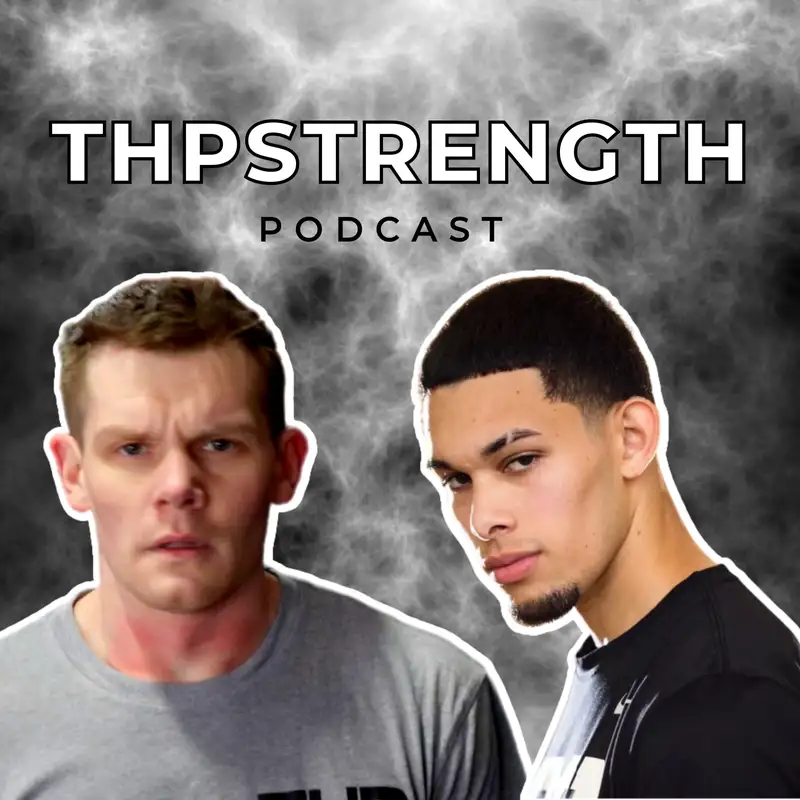
Strong Athlete Loses Bounce... Here's How To Get It Back
It takes about a month to detrain your max strength. So if you touch on it about once a month, hit 90% of your max, you'll probably retain most of your max strength gains. Power, on the other hand, is about ten to fourteen days. If you go that long without touching any power work, it's gonna start to detrain. Elasticity is three to seven days, and then speed is, like, one to three days.
Isaiah:We made an entire podcast about that around a week ago, but what about retraining? What if you have lost it? How long does it take it? How long does it take to get it back? That's what we're gonna be covering today.
Isaiah:My name is Azir Rivera. I have a 50.5 inch vertical officially tested. This is John Evans. He is the one that got me from a 42 to a 50.5. He's also coached four of the six athletes that have tested a 50 either through a max touch test or by flight time.
Isaiah:Four out of 67%. Pretty good. Pretty damn good. And, yeah, let's get into it. If you wanna get coached by us, by the way, link is in the description or in the pinned comment.
Isaiah:You can get six months free when you get the yearly plan. So if you want details on that, just click those links below. So let's get into it, John. You have any questions ready for us here?
John:I have, like, a yeah. I have a few. And I guess you kind of answered the first one, and that's what what do people usually mean when they think about retraining timelines. And it's, you know, a scenario that Isaiah and I just ran into. Essentially, we had a period of detraining.
John:Right? We didn't do really anything for a period. Isaiah's was about two weeks. Mine was about three weeks because whatever reason Isaiah's case was an ankle flare up kinda weird thing. In my case, it was a hamstring issue.
Isaiah:The way was the longest I've ever gone without training legs since
John:Hell, yeah.
Isaiah:Probably 2017. Like, legit. Actually, maybe even longer. Like, I think even in 2017, I was training my legs through jumping at least, like, couple times a week.
John:Yeah. So retraining is really, a retraining timeline is how long does it take to get back to the level that you detrained from? So for example, for Isaiah, if we look at where his strength levels were, your max squat was, what, four Four forty. Two hundred kilos. Four forty.
John:Right. Two hundred kilos. Two hundred keys. And then power clean was three thirty. It was a 150 kilos.
John:Oh, dude.
Isaiah:Those are crazy. A 100 Yeah.
John:I was gonna say, you're at a beautiful, beautiful combination right now for
Isaiah:I'm not gonna do my max. Like, that's that's I like those two numbers. One big
John:No. Don't don't get them any higher. Just move them faster. We're just gonna hit v load power output.
Isaiah:Or train, but never max out. But never max out. Yeah.
John:You'll just be like, alright. I just did triples tuner at cheapest. I'm never gonna go above it. So the the question, yeah, would be, like, for each of these different metrics, how long does it take to get back to that level? And I think a lot of the time
Isaiah:define each of them can we can you define max strength, power, elasticity, and speed really quickly?
John:Yeah. So max strength would just be, irrespective of time, how much load, weight, whatever, can you move a given distance in a given constraint for for whatever exercise. So if I said a back squat, what's the standard? Full range motion, you know, hip crease below the top plane of the knee. In my case, I usually like to see thigh cap contact as deep as they can go safely without the back rounding.
John:That's usually my definition of it. So I would say, okay. Irrespective of time, how much can you lift up concentrically? That's one type. Then power is typically also a concentric measure.
John:So I would say, what is the a weight you can move a given distance in a given exercise and how fast can you do that. So for example, if I'm looking at power clean, then it's gonna be either watts or I'll just use the total load because to get the the weight up a given height, which in Isaiah's case is about, I think, 38 inches. The bar has to move about 38 inches. If it doesn't move 38 inches, he's not gonna be able to lift it, and that
Isaiah:is Side question. Is a power clean a max strength exercise or a power exercise? If you're just seeing how much you can power clean.
John:It's definitely a it's definitely a power exercise because you are limited not by max strength, but by power and how much weight you can do. It is it is respective. It has to respect time, the time interval. It's forced over a given time interval and then also the the distance that you can do in a given time interval. If you don't have that prerequisite, you can't lift the weight.
John:So you need to hit a certain power output. Whereas it doesn't matter how slow you lift a squat. Right? Time time is irrelevant. You could do it over twenty seconds if you wanted to to get your max.
John:Yeah. Obviously, that wouldn't happen. But yeah. So power clean, definitely power exercise. But you can do it you can do tons of different power exercises.
John:I mean, technically, a standing long jump, standing triple jump is like kind of a tweener. You could do what I was doing on the box today where it's a step up jump. That's a power exercise. Hex bar jump, power power exercise. And you there's also eccentric and concentric and isometric.
John:Like, there's powers measured, I guess not isometric because, technically, you're not moving a distance, but you could do rate of force development, which is a measure of power in my opinion. Yeah. But, yeah, go ahead. What were you gonna say?
Isaiah:Would you say that it's more, like, dependent on your concentric abilities in a power exercise? Like
John:Well, so we only care about the concentric okay. How do I say this? The concentric output in a power exercise is relevant because we don't have the luxury to do elastic. You're doing it because you can't do it in the form of elastic an elastic variant without some sort of consequence. So for example
Isaiah:But you could you could make a a power exercise more elastic by adding Yeah. You could.
John:Yeah. You could. You could, but it would still be kind of at that point, you're you're Kinda like our our drop cleans. Exactly. Yeah.
John:But then but then you're kind of in this in between of, like, I would call it, like because I don't like those terms. I typically use the term strength, speed, and, like, it falls somewhere in there. I don't even use the word elastic, like elasticity. That to me is, like, kind of coordination, but I'm not gonna get into the logistics of that. Just for the sake of simplicity, yes, what you said is true.
John:So, like, you could bridge between speed and strength and be a speed strength exercise or strength speed exercise, and those have subcategories of, is it an eccentric speed strength exercise? When you talk about how well you use it, like what Rolf was talking about, like DIS, it's how fast can you go down and still get a really high concentric VLO? Because, like, you could go down crazy fast at super high loads, but if you can't convert that to a fast concentric load, then it doesn't really matter. That means you're not using the eccentric load to get a higher concentric load. You could overload it Now wind and potentially Exactly.
John:Yeah. You're not getting a true stretch shortening cycle because the goal of the eccentric load like, the down phase is to increase or augment the concentric output. So for example, if you're in a squat jump, your squat jump's the same as your counter movement jump, you're not using your eccentric capacity whatsoever. And so what Rolf basically was saying is, like, if you max out the eccentric side of things, it didn't necessarily make the concentric VLO go up. Right?
John:They just got really, really strong, and and there's, like, some disconnect there. The ability to use the eccentric concentrically, there's a there's a specificity, a gap between those two things that you do have to cross, and that's kinda where we were with you was being able to take those eccentric strength numbers and then do it fast. So now we take this eccentric strength that you've developed. Now we've gotta do it fast and use it to store and release elastic energy and increase the concentric output because you did
Isaiah:a counter movement with it. Which answers the question, what's elasticity, which is basically loading up eccentrically. And then Yeah.
John:Exactly. So it's like, wet loads. Yeah. Yeah. How do you do you get really, really high loads when you load eccentrically?
John:And I think one big problem that I'm realizing more and more and more as I'm kinda talking about this is people do too much weight on the eccentric, and their concentric outputs go down because the eccentric loads are too high, and they can't actually convert it upwards. Like, you need to see a positive concentric output relative to without that eccentric output for it to make sense. Like, otherwise, it's just like you're not really over you're like learning a bad a bad strategy.
Isaiah:Yeah. To give you guys a visual of what that means, when I was doing depth jumps, the infamous 60 inch depth jumps, they were elastic in nature because as the box height kept increasing, my vertical kept increasing. So the the output we were seeing concentrically was going up and up and up. So what John is saying is the point where that doesn't occur, it stops being as elastic in nature.
John:Yeah. And you kinda have to ask yourself, like, what what are we really doing at this point? Like, we're not getting energy out of it, which there's so many interesting things about that as I've, like, studied the nervous system because, like, world class coaches will go up in heights and then back down. Right? And they never really go above, like, 60 centimeters because the rate coding changes, the ground contact times are different, and it just ends up not being specific for most most athletes.
John:Like, your ground contact times really didn't go up that much. It's infinite height. And I think one other question that I would maybe ask is if I did a counter movement jump, were you jumping higher on a counter movement jump or were you jumping higher on a depth jump or were you jumping higher on a spot jump? Right?
Isaiah:I was I was touching eleven four.
John:What were you touching off the counter room and jump?
Isaiah:My best ever is whatever 40 is or just shy of 40. My reach is eight one. Yeah. Eleven four to eleven five is, like, my best ever standing jump.
John:The best ever. But on that Yeah. On the I don't remember. Actually, was that the day you had a crazy counter movement jump, like, standing jump?
Isaiah:Nah. Nah. It was around that time period, but it wasn't that Okay.
John:Yeah. I mean, it it kinda, like, brings in a question of how does that change things at that point. Right? Because now you're adding even more eccentric load. What's the optimal eccentric load off a depth jump where you'd actually surpass your counter movement jump, but that doesn't even work because the goal of the depth jump is storing and releasing energy, like, effectively, and it's respective of time.
John:You want short time intervals, so you're better at storing and releasing energy. But counter movement jump, you don't care. You only care about output. Like, I said step off the box, but as much I don't care how much time you spend on the ground. Just jump as high as possible.
John:Like, that would be kind of a more interesting
Isaiah:I I need to I wanna watch that workout again because I don't remember if we were, like, we had it at a certain height and we were touching the same height and seeing when I stopped touching it. Like, we might have
John:said We just I think I think I just wanted to see how high you could wait. I don't remember. I think I was doing it based off I think we started low, and then it was like, okay. Let's just increase the height of it, and you just kept jumping higher as we move the box higher until it was a point of, like, I think off yes. It might have been the highest off the highest one.
John:I don't remember. We're go back and watch. But interesting.
Isaiah:So alright. So we got the definitions. We got the definitions down.
John:Yeah. A bit of a tangent there as per usual.
Isaiah:Yeah. I mean, I think it was a valuable tangent.
John:It was. It was. So speed speed will go from, like, the most sensitive to the least sensitive. Speed takes a long time to retrain. Once you lose speed, it can take, like, months and months and months to get back.
John:And that's the dangerous part and the very difficult part about speed training is that people don't realize once you lose it, it is very, very hard to get back. But if you're more elite, you'll train it faster. So the the less elite you were and, like, you know, however fast you got, it is kind of like, related to those two things. So if you're, like, really, really untrained, you haven't done it for a really long time and you never were really that good, it's gonna take a while to get back to, like, where you were. But elite athletes, guys that ran, like, 12.1 meters per second or whatever else, if they had, like, a period of detraining, maybe, like, let's say six months and they weren't crazy detraining, they'll train back.
John:They'll train back to that. They'll detrain further, but they'll retrain faster. So, like, you're they'll go from twelve one down to, like, 10. Right? Versus, like, the, you know, the fat couch potato might have gone from, like, nine to eight or whatever.
John:It'll take him a while to get back to to nine. But the guy that went from that had and he only the difference is one meter per second at top VLO. The elite guy can go from 10 to 12 in, like, super fast. I wanna say speed is a little bit different, but they'll they'll do it, you know, potentially a 100% faster or or quicker to get back to where they were. If you're looking at, like, RSI and stuff like that, it's somewhat similar.
John:It's kind of in between power and and, like, true speed work because you do have time on your side. Like, you can get away with being on the ground a little bit longer. The shorter interval of time that you have, the longer and more difficult it is to retrain. So that one I would say that one's like same thing. The more elite you are, assume that it's gonna take about half the time to get back to where you are.
John:That that one's tough. I would say, anecdotally, oh, man. It can take that one can take a while to get, like, good stiffness back because I think the highest stiffness I've ever had on an RSI test with my arms was, like, three four using flight time and contact time or something like that. Do you know what yours is? It might have been higher.
John:I might have had
Isaiah:three eight.
John:Think mine is high threes. So I think that yours is, like, pretty similar
Isaiah:to mine. Three nine.
John:Yours is, like, pretty similar to mine, if I if I remember correctly. So yeah, that one, if you lose that, depending on how it depends on how far you detrain, like, how bad you are. If you're two fives, it's gonna take like, it could take years to get back to, like, close to four because four is just a it's a fucking crazy number.
Isaiah:So You also gotta think about the base that you built. Like, if you've been doing a RSI stiffness hop test three times a week for ten years and then you take a month off, it'll probably come back pretty quickly when
John:you get back
Isaiah:to it versus if you've only done it for six months and then you took a month off. It'll probably take longer to get back whatever
John:you did. Yeah. It's like it's kinda contingent on those are sliding scales, you know? Yeah. Like, How about lead are you?
John:That's gonna determine how fast it comes back.
Isaiah:How far did you The hay in the barn. We always talk about the hay in the barn. The retraining timelines is based on how much hay you had. Because, like, when you're taking them off, you're just, like, shoveling hay out of there.
John:Yeah. You're just you're just there's no hay in the barn. Right? Yeah. And then, I mean, on top of that too, that that one's contingent on health.
John:So that that's a that that can be a really difficult one. Like, high jumpers who lose a lot of stiffness, like, they would it takes a long time to get back to their all time best. You can get within, like, 95% pretty quick or, like, 90% pretty quick. But that last 10%, that's where it gets really hard to train up to. Whereas, like, if you're you were never really good at it, it might probably take, like, four to six months if you've, like, pretty much fully detrained.
John:You know? It's it's pretty long. Power is comes back pretty quick. Like, you're just looking at peak watts on things like a power clean and stuff like that, it's sensitive, but it's not nearly as sensitive as the ones that are more dependent on time. Because when you have more time, it's easier to like, those variables come back way quicker.
John:I would say, like, peak watts, you can retrain that in, like, forty eight weeks. If you're, like, fully fully detrained, you can get within 95 to 98% because it's more like strength, and strength doesn't detrain very fast. So it you know, the things that like, speed, like I said, it's it's hard to get. It's really hard to get, and it's easy to lose. Elasticity, same thing.
John:Really hard to get. Pretty not that easy to lose, but, you know, it's not as hard to like, it's easy it's not as easy to lose a speed, but it's somewhat close. Power is like you can train it pretty fast. Yeah. You know?
John:You don't lose it very quickly. And when you do lose it, again, you can you can retrain it pretty quick. So it's like how long it took you to get that thing in the first place. It doesn't take you as much work to get it back, but it it's still gonna take, like, quite a bit irrespective of what the quality is. But the ones that are really hard are elasticity and speed.
John:You never really wanna lose those. If you don't touch on those and you lose them, they're really, really hard to get back within, like, 95%. And then strength, that one, I mean, that one trains up super quick. I've seen guys get their strength back in, like, two weeks.
Isaiah:I actually it's funny. I just remembered this video that I watched recently. His name is Ankiri Elite Fitness, I think, on YouTube, but he he made a video. And he basically he does a lot of, like, Olympic lifting, power lifting, like, that type of thing. He'll do voice overs over him him training.
Isaiah:And one of the videos he recently put is called I got strong but lost my balance, the athletic trade off no one talks about. And in that video, he actually talks about how when he was younger, he sprinted a lot, jumped a lot. Think he's, like, five seven, could, like, grab a rim, like, jumping. And then he focused on, like, Olympic lifting and just getting super strong, and he got really concentric like, he'd be, like, a concentric monster essentially.
John:Yeah. Like, squat jump is higher than counter movement.
Isaiah:But he talks about him trying to get his sprinting back and it's taking forever. And it's like
John:It's like Bumstead. Chris Bumstead is like the same thing. He Yeah. Like, he's a prime example of it. He he didn't sprint for years, just became huge.
John:Was I think he was a high like, high school decent high school football player. I don't know if he played in college, but, like, did quite a bit of running, and he can't run without, like, getting hurt. You know? It's like, that's why you never really wanna let yourself fall off too too far.
Isaiah:You don't You don't stop dunking because you get old. You get old because you stop dunking.
John:Yeah. Exactly. And I think it's the same reason why
Isaiah:printing with dunking. Yeah.
John:Same thing. Like, if you don't run fast often, it's really it can be really hard to get it back. It takes quite a bit of work without getting hurt. And so, like, it's important to maintain it as best you can by doing, like, return to play type activities for sprinting because you can retain those qualities better than you would had you done nothing. You know?
John:Cody Cody Bidlow posted about this. He just had, like, a a hamstring pull recently, and he's know, you in his description, he was like, yeah. The ways that I get it's pretty simple. He's like, you remove the load. You graded exposure, like, increase the load, and then you cross cross education, which I I've been a long long time fan of.
John:Like, if you for example, with your foot, you can't do it on the right foot. Okay. We're gonna do a lot to work on the left leg because there's some cross education there. It'll maintain some of the elastic qualities that you would have lost, and the retraining timelines are shorter because of cross education because you'll maintain more, but then you forget what did.
Isaiah:It was my
John:Exactly. At the playground. No. Exactly. Yeah.
John:Isaiah Isaiah was hopping up on a single leg. I was like, you can't go single leg without doing anything. And I didn't scold him because I was like, nice. It was like, I didn't think you could do it. I didn't think that you'd be able I I was worried you wouldn't have the health to do that, which I think we probably tomorrow should go over what happened because we haven't really talked about it.
John:Did you talk about it in your YouTube video?
Isaiah:No. Literally, nobody knows. Oh. Yeah.
John:Isaiah had a tragic injury building a handbrake for his sim racing setup. Yeah.
Isaiah:So lame.
John:Yeah. It is. It really is lame. But that is the video, guys. I hope
Isaiah:So we got Alright.
John:We I did say all of them. Yeah. I said all
Isaiah:of them. To to summarize, let's say you have someone with a high training age, call it three plus years, they take a month off. How long do you think their sprinting is gonna come back?
John:They're training you just three years?
Isaiah:Yeah. And
John:they take a they take a month off?
Isaiah:Yeah. Is it twice the time they took off, half the time, equal amount of time? Your best guess.
John:How elite were they? Like, what was their hundredth time? Eleven eight. Eleven eight?
Isaiah:Yeah. Call it twelve seconds. Call it twelve seconds.
John:Twelve seconds? And they only detrained for a month, and they trained three years to get to that point?
Isaiah:Yeah. They took a month off. I mean, they're
John:mean, but they're, like, not a very good athlete. If you train three years to run a twelve second 100. Yeah. Yeah. So
Isaiah:But you have tight training. Might take that might
John:take, like like, assuming you don't get hurt and you can train all out, you could probably get back in, like, I don't know, three or four weeks. It's, like, not gonna take very long.
Isaiah:Alright. Same question. Your power
John:clean. Person?
Isaiah:Power clean? Same person for
John:power clean. Clean,
Isaiah:two fifty. Two fifty?
John:Oh, that's pretty good. So that would take they can hit two fifty, train three years to get there. They detrain for a month. That one might take They're sitting on their couch. Probably two to three months, I would say.
John:Because that's, a better met like, that's a that's a two fifty power clean is much better than twelve second 100. Like, twelve second 100 is slow. That's slow. That's not fast. But, like, a two fifty power clean is actually
Isaiah:Alright. 11511500.
John:115? Yeah. Let's say 113. Like like, two fifty is probably equivalent to, like, low elevens, I would say. Okay.
John:Okay. So to get back to that, if you detrain for a month, I mean, you're you're gonna have to build back probably probably, like, four months, maybe. Four months. Five it's gonna take a little bit because those are all considerations.
Isaiah:We're we're at three to four x time off, basically, for the elastic quality, and we're about Yeah.
John:Maybe more. Maybe more.
Isaiah:One one to two x of the time off for your power work. Yep. Max strength now. So they can
John:Probably probably a week, two weeks. Yeah. Like, the I they're just, based on where they're at.
Isaiah:And you'll get back. Let's say
John:Like like, for you, you're a prime example. You're a prime example. You detrain for two weeks, and I've seen Donovan do the same thing. He detrained for, like, four weeks or something like that. Right?
John:Like, didn't even touch it. Yeah. Okay? Comes back in, does it for he the first week, I'm so weak. I know.
John:I'm like, what do you what do you think your max is? I don't know. 380, three seventy five, and his previous max was 425. It's like a 50 pound drop. And I looked at him, and I was like, I guarantee next week, you're gonna feel stronger than you ever have.
John:Next week comes in, hits a PR for rep rep max squat that estimated his squat at, like, 40 pounds more than he'd ever done. It was, like, not surprised. Today
Isaiah:was interesting. This will be the last thing I mentioned. I did I PR 200 kilo back squat. Then for a month straight three weeks straight, we did no max strength squatting, maybe, like, a feel good lift. I I got, like, two feel good lifts in.
Isaiah:Did a lot of eccentrically overloaded belt squats, but took the concentric work basically out. That's, like, the max strength concentric work. So that was three weeks, then I just took two and a half weeks off doing nothing on my legs. And today, three fifteen for three was kinda hard. Like, I think my max probably is right around there, that, like, three eighty mark.
John:Similar to, like, what Donovan dropped down to?
Isaiah:Yeah. Yeah. And I promise you probably the same thing. Two weeks of I promise you that'd next
John:week, Wednesday next week, or Monday. Let's say you do nothing on Friday. Monday, you're gonna be like, oh, I feel strong. Like, I feel like I can move some weight. There's some other contingencies there too because the reason why is, like, a confidence thing too.
John:Like, you're not crazy confident, I think, is your ankle feels better and you get more confident. Yeah. It's gonna, like, it's gonna be exponential. You're gonna have, like, multiple variables working for you and getting your return to to strength levels, which two foot jumping is so strength dominant. I'm realizing this, like, more and
Isaiah:more and
John:more as I've kind of worked with so many elite two foot jumpers, like, at that crazy, crazy level. You guys you you really are fueled by max strength and, like, just peak power. Like, I think people underestimate that so much. Like, that is such like, they're so important. I can't even emphasize how important they are.
John:And I
Isaiah:I put a before and after me doing three fifteen. It was like a dead lift at first, and then the other one was a power clean. And then I'm over here, like, damn. Was so weak. But then people were, like because I look skinny.
Isaiah:I look like a little kid. Mhmm. And I'm just I'm looking through a team, and people are like, what the hell? Like, you're still strong.
John:By that?
Isaiah:Yeah. I weighed, one fifty or something.
John:That's the nervous system, baby. That's the nervous system. You gotta train the nervous system. You gotta you gotta train a lot of things, but the nervous system is really important.
Isaiah:You gotta be an athlete, man. Be strong. You
John:do. There's a lot of there's a lot of things you gotta improve. But, yeah, I think those you can never get too far away from from those at any point, like, truly, because those those are, like, the you build off of those in any condition. That that's that's the basis for jumping higher off two feet. And if you don't have those, you you can't do the other stuff.
Isaiah:I actually see it as it's like sorry. I keep extending the podcast. But I have, like to me, I have this internal clock. It's about a month. We're, like, if I get away from max strength work for, like, a month or more, then my vertical starts going here.
Isaiah:Injuries start going here, start feeling a little worse. I mentioned to you multiple times while I was taking this time off and now we're getting back to training. I was like, dude, I'm not like these genetic freaks that don't train and can jump 48 to 50. Like Like, would detrain so hard. If I get away from my max strength work, I literally went and did an RDL the other day, felt like my hamstrings are pulling, then I go do freaking bell squats, like, getting PFP joints are like yeah.
Isaiah:I was like, bro, like, I need to train. Like, I need like, you guys don't understand. I'm a I I consider myself a hyper responder to training, but I'm like a hyper, like, de responder to train.
John:I don't exactly what I just said. More elite guys are gonna detrain so hard. You guys detrain so well, specifically, you will detrain so quickly. Yeah. And you'll get you'll lose fitness so fast.
John:And I think, like, you know, there's there are the genetic freaks that that's not the case. Like, you and I were talking about, okay. Well, who are the one foot jumpers out there that have really made, you know, a a lot of progress that aren't, like, genetic freaks or whatever else? And it's just like, oh, well well, they just jump all the time. That's all they do.
John:They just jump all the time. And it's like, okay. They're a genetic freak in a different capacity. Because if I do that, I'm I'm wrecked. There's no way I could do it.
John:I physically wouldn't be able to do it. I think you're the same way. Like, we just we're not outliers in that regard, and I don't think any amount of, like, load capacity would like, load management really get us there. Like, we're at some point, we're gonna need the weight room to to stay healthy. And that's why that that option is always pushed out of my mind.
John:Like, I'm just like, this is this works for people if it works for people. This works this works for you if you can do it. And even then, I think it's still limited. It only works in specific instances. Yeah.
John:If you're super light, you have a really good nervous system, you know, you can handle jumping super high volume, then, yeah, and pretty stiff tendons is it's probably gonna work. But, like, if you're kinda pudgy Yeah. That's not a thing. Like
Isaiah:I I think that is why THP sees the success it sees with our elite guys because other programs, it's like it's so many so so many of them are, like, people that are genetic outliers. You take all the weight room workout, they jump higher, but that doesn't work for like most people that does not work. That does not
John:work for 90% of people.
Isaiah:And we were it's almost it was like a perfect storm because you're that way and then I'm that way. And then I have above average genetics for jumping, but not in that regard. So it's like I had to use those principles and then it worked. And then you use that for other guys and it just it works so well.
John:Yeah. And I think I think, like, that's something that an athlete told me once. They they said, you know, it was it was Hunter Lapair. Shout out to Hunter Lapair. If you guys remember Hunter, leave a comment in the YouTube.
John:Just comments. But Oh, do you that? He was like, you know, the reason I gravitated towards you guys versus all these other people is because you make average people better. You you can make the elite guys better, but you make average people better too. And I'm like, yeah.
John:Because that's like, you have to do the things that you know work for 99% of the population. And if you take those concepts and you apply them to the elite guys, generally, it works too. Now there are very few outliers. Like, if you have a thoroughbred horse, like like a like a Dylan McCarthy or a Donovan, the rules are gonna change a little bit. They are.
John:They're gonna change a little bit. You gotta do more of, like, kind of the stuff that role suggests. You they can handle jumping more. They don't really have to do much in the weight room. They can always do fast elastic stuff.
John:They're crazy resilient. They don't really have to worry about staying healthy. Like, they're kinda easy to coach and honestly, they can just do the skill and generally get better, but that that doesn't work for ninety nine percent of people past okay. Let me say this. If you're post puberty, that doesn't work for, like, ninety nine percent of people and I think that's where we we do separate ourselves and why it works for so many people.
John:And don't get me wrong. There are cases where we will tell people if they're truly, truly freaky or or they're before 13 or 14 years old, we'll tell them, like, hey. You can you can go just jump, you know, until basically as much as you want and and don't get hurt. And it'll work for them, but that that's not true for the vast majority of the clients we have. I would say, like, I can think of maybe, like
Isaiah:It's literally
John:90 like, over the last six years.
Isaiah:Yeah. It's like 90 most people are average. Yes. And then And even if you're above average, it's like actually, if you're average to above average genetics, it'll work. And then if you're the top 1%, you will know.
Isaiah:You will post a video on Instagram, and it will go viral because it looks freaky. You will know.
John:And then eventually, you'll probably still need a trend. That's the other part. You'll get capped at, like, 47, and you'll be like, oh, I should probably start doing something eventually. And then you and then you'll hit 50.
Isaiah:And then you'll get to, like and then you'll only add, like, an inch or two. Yeah. And then
John:and then you'll really need to, like, be smart, like, really smart. McCarthy is a good example of this. McCarthy has been, like, a a good case study of this, like, where he's, like, really improved a lot. He came in with a pretty high vertical. He's interesting.
John:We could talk about him another time. But that's the podcast, guys. I hope you enjoyed it. I hope this was interesting for you. If you're interested in coaching, click the link in the comment section or in the description below, and we will see you guys next time.
John:Ciao. Bye
Isaiah:bye.