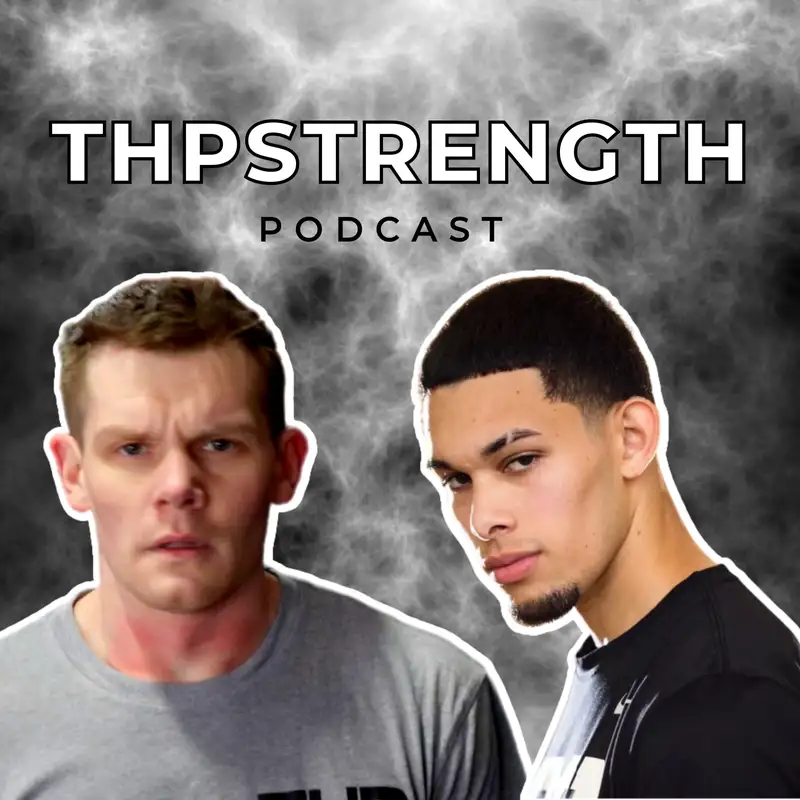
Isaiah Rivera's Plyometric Workouts Are Supercharging His Vertical
In one week, my flight times went from point nine five, which is around 48 inch vertical, to point nine seven, which is around a 50 inch vertical. My ground contact times went from high point two nines to which is very slow on the ground for me to point two five, somewhere in the point two five, which is very fast for me. And, again, it was just one week. So we're gonna talk about what led to those changes. If you've been keeping up with the podcast, you probably have an idea and our thoughts about it.
Isaiah:But with that before we get into that, I just wanna remind you, if you want six months of free coaching when you buy six, you can click the link in the description or in the pinned comment or go to thbstrength.com.
John:To be clear, it's when you buy the annual plan. Yeah. Purchase the annual plan. Alright. So let's let's talk about this.
John:So for those who don't know, Isaiah's been doing he struggled with his eccentric rate of force development, and this was evident a number of ways. We talked about this at length. In short, he had long ground contact times, wasn't jumping high, but on full approaches. But when he took in less speed, he was still getting relatively high. So the last week, we've started this very intensive eccentric dominant cycle.
John:And I was I was telling Isaiah this. I was researching Virgosianski before this because I I don't know. For some I was gonna do a video on his his plyometric progressions. But one of the things that became very apparent, and I very much agree with, and my mentor Mike also is on the same train of thought is that he was very specific about the volumes of plyometric volumes starting very, very low and bleeding them in at the right times. And then on top of that, he, like us, did long conjugate sequence systems.
John:I think a lot of people think that he was just block. That's actually Isarin and Matbiev were more on the block purization side of things. So what he
Isaiah:What's the difference between block and long conjugate?
John:Block periodization would be that you do only one thing. Long conjugate would be that you bleed in other variables because you don't have the luxury of you don't have the luxury of losing the training effects of the previous cycle. You need to maintain those. And you'll detrain them very quickly, but you also train very quickly. That's what elite athletes do.
John:So you have to be very careful about how you bleed in plyometric volume, and you need to do it in very, very low volumes. And I think most people do not do this. I think most people put them way too early, way too intense, and in volumes that are way higher than they would need. And then on top of that, especially if you have an athlete that's already doing jump training or jumping, specifically having dunk sessions, then you really have to be careful. And so one of the things that we were not gonna do is have Isaiah jump because of that reason, but I also wanted those faster ground contact times and start to what he would call, like, transmutate some of the adaptations from the accumulation.
John:And the whole logic behind it is that as specific specificity goes up, your performance should go up. And their nervous systems are very sensitive, so you need these periods of unloading for them to respond, which we do very well. And it's very in line with the Jonathan special where we're gonna see intensity climb up. General work is gonna go relatively more general on the general stuff, but really specific on the specific stuff. So that way, we're able to see these good adaptations in that last week.
John:It's an unload, freshen up, nervous system gets sharper, and, you know, the the sensitivity of your body increases. Like, you you can handle very sharp, fast contact. So we've been doing a ton of long length accentuated eccentrics so we can get those sarcomieogenesis, and we've been doing a lot of plyos and acted like double dip plyos. And I like double dip plyos because you're able to increase the time and retention, and you're able to get more loading at long lengths. But it's sustainable or tolerated well because you're not landing from a really high height.
John:So the ground contact times are longer. The velocities are lower. It's a vertical plyo, and it's a rebound. So you're gonna have relatively high loading there, but you're not rebounding in succession what you would call, like, multiple stim stimulus in the sense of, like, repeating the same type of ply over and over and over again. So sometimes when you reintegrate them, you'll use double dip.
John:Sometimes you use triple. You could do, like, three easy bounces than a hard one. I just did one easy bounce, one hard bounce to try to reintegrate this stuff. And it was interesting because now I have three athletes that are on this cycle right now. I've got Isaiah.
John:I've got Ethan, and I've got Josh on the cycle, and each of them are adapting very, very differently. Each of them are feeling very different things. Yeah. So you and Ethan are I haven't talked to Ethan about how sore he is, but Josh is, like, very, very sore. Like, his hips, his hamstrings, his quads, everything is lit up, and that's because it's more novel.
John:And he doesn't have the same vertical that you guys do. So he's seeing these loads that are the same as you, but he doesn't have the same eccentric force generating capacity. So the volumes are the same. The intensities are relatively the same. You guys are hitting the same loads very close.
John:Maybe his are slightly lower. But his level of soreness and subjective assessment of how he feels is way different than you guys. Like, Ethan hasn't really said anything. You haven't really said anything. Josh is, like, getting absolutely wrecked from this stuff.
John:So I might have to cut his cycle short, in comparison to you guys because he's gonna put himself in more of a hole.
Isaiah:What's interesting is I've been able to tell that remember remember I was telling you I just Mhmm. Don't ask me why.
John:He's fast as fuck, boy.
Isaiah:I I it's because I have a three year old dog. But I was telling John the other day, I'm like, hey. Like, I'm just breaking out into a sprint in the house and I'm like feeling like a a gazelle.
John:Like Bouncey, baby.
Isaiah:I can just tell, like, just when I run, I can tell when I'm amortizing more quickly and efficiently.
John:Yeah. And I think one of the things too that a lot of people had a misconception about even Virkoshnansky to a certain extent would say, like, oh, you've gotta train the tendons, you know, through these extensive plyos, but evidence is pretty clear that's not what happens. The strength work is where you get the tendon adaptations, but the neuro the neural adaptations from this stuff are insane. Like, know, you're not it's not like your tendon is getting more elastic or compliant. It's that your intramuscular coordination is getting way better.
John:You know, you're able to time things up. You're able to recruit force fast. It's waking up your nervous system. And we wanna use it sparingly because you can quickly put yourself in a hole if you dose these inappropriately. And I've done it numerous times my to myself.
John:I don't do it to my athletes, but I like to test different hypotheses. And some of the worst jumping I'll have is when I hammer play a volume. A lot of bounding, a lot of depth jumps, stuff like that. I'm just super flat. I can't yield appropriately.
John:I feel slow, sluggish. And I think you're probably getting to that point now where you're starting, like, from today's jump session at least. Like, what were you telling me before we got on the on the podcast?
Isaiah:Yeah. I I only did 10 hard jumps, 10 to 12 hard jumps. Actually, might have not even been that many. Was like
John:a lot of jumping, but, yeah, the hard ones weren't that many.
Isaiah:Yeah. Like, hard jumps, it was it was around eight to 10, and my nervous system would just shot. Like, you you haven't seen me now for the last two hours. Like, I was like a zombie dude. Like, I I was so freaking yeah.
Isaiah:Because my nervous system was dead. What's interesting is coming into the session, I was not expecting a good jumping day at all. Like, if you would have told me today that I would have jumped this high, like, I would not have believed you. Like, I I
Isaiah:would have expected to jump, like, 46 today.
John:Yeah. I I think it's a it's a testament to the adaptations. Right? Yeah. Like, you know, you're doing power work, and we're seeing the adaptations set in.
John:The question is how far can we push that before it goes the other direction? Because then it's The other direction your vertical going down.
Isaiah:Yeah. I mean, usually, I'm like a week one adapter. Like, almost every time you put me, like, in week one of a cycle, whatever we're working on, I feel like it spikes. Like, my max strength will spike or a power clean PR, cycles like this, you know, my ground caught 10 times, dropped, jumped higher. But then week two and week three, I just literally that's or that's usually when I start getting into a little bit of a hole, but we'll see.
John:We'll see. It's gonna be interesting to see how you're doing.
Isaiah:Three week cycle or four week cycle?
John:It depends on how you come into Monday and how your jump session goes next week. If you're dropping off really hard next week, then it'll definitely be two weeks. I won't I won't push it a third. I want to because I like to see you suffer. But Yeah.
John:At that point, you've gotta you've gotta recover. And I and as I was researching Bert Koshansky, he was he was very similar in that regard. You know, everything was very flexible. Everything it's systematic in a sense, but there's, you know, realistic adjustments that that happen with guys like you. I think most people don't need to do that.
John:They're gonna benefit from just grinding it out. At your level, we're dealing with a sensitive ecosystem, a very sensitive biology, and the biology and physiology is determining those adaptations, not my preference. So I wanna see you know, I might have something, you might always use to say, write in pencil, and I very much agree with that. I think that you need to be willing to adjust the cycles, you know, when when the time comes. You know, it might be something where we come in and I push you on Monday and then back you off, you you know, the remainder of the week or we drop volumes, but maybe we have the same focus and then we start to shift some of those modalities the following week.
John:So, like, for example, if you're doing this, like, extensions, you know, eccentric max at end range, maybe towards the you know, week four, those are coming out. But I what I would like to do is get at least I mean, this week, we probably accumulated four sets of five is four sets of five with a five second count, so you had twenty five seconds per set. So you got a hundred seconds of eccentric loading on at end range on one day. And then Monday, you got another I think it was three reps with a four second count. Was it four four reps or three reps?
John:I think it was four with a four second count.
Isaiah:Yeah. Four.
John:So you got sixteen seconds per set times four, you're getting that's twenty four plus forty, sixty four seconds. So you've almost accumulated two hundred seconds. I mean, you're you're at less than that, but, I mean, you're at what would that be? It's a 100 so you're at a hundred and sixty four seconds of long length eccentric work on on that stuff. I mean, we're not even accounting for the plios, and we're seeing the adaptation set in already.
John:So what'll probably happen is the the following week, this week, I'm assuming will be I I'm leaning towards three because I don't I don't think you're gonna be able to handle a four week cycle. I think you're gonna need to unload, but I'll keep it very sharp and fast on that week three. So you'll still be doing power cleans for power. You'll still be doing jump squats for for power, probably probably with a hex bar. I think I think your spine is a delicate flower.
John:Yeah. That would I literally told Isaiah, was like, don't like this. Like, this is a lot of load on your spine. Like, I'm fine. I'll be alright.
Isaiah:Yeah. Back before the next day.
John:Yeah. And I was like, yeah. I I thought that was gonna be the case. But, dude, the data indicated I had to keep going up. I didn't want to.
John:I didn't want to. I just had to.
Isaiah:Is indeed my limiter in that.
John:It's just it was lot of Yeah. Thirty one hundred thirty one hundred watts in a barbell squat jump at three sixty five. Like
Isaiah:Bro, what a week, actually.
John:Yeah. You had a hell of a week. Training wise, this is on paper some of the craziest metrics. You know? Yeah.
John:Peak wattages that are crazy. I had a guy in my comment section say those wattages weren't possible, and I was like, you're definitely thinking of average. Peak wattages, that's possible. But thirty one fifty at a 185 pounds, you know, watts per kilogram, I think it's around 33, 34, something like that.
Isaiah:Yeah. Like 34.
John:Did you do the math yet?
Isaiah:That that was my previous PR. Thirty one fifty was? No. Or it was on the hex bar jump. This one might be higher.
Isaiah:You said thirty one fifty? That was the the wattage?
John:Divided by 84. Yeah.
Isaiah:3150 divided by 84. Wow. 37.5.
John:Yeah.
Isaiah:That's good.
John:That's really good. We're we're we're getting close to 40.
Isaiah:I mean, I'm definitely I would have tested 50 today for sure. Mean, if you woulda I was ready to pull the the vert trainer out, and then I felt a two out of 10, so I, like, cut it. But I think, like, twelve three for sure. Like, I'm thinking how I felt last week, and I was almost touching twelve two. Like Yeah.
Isaiah:I think twelve three would have been eat like Your
John:your warm up was way better this week. I mean Bro,
Isaiah:I'm I'm probably gonna start playing one on one every week. Even if it's, like, get Josh out there or, like, Dom or something, just I'm gonna abuse them. My fear
John:My gum shot. My fear is your ankle. That's that's my fear. But, hopefully, that that
Isaiah:One on one. If it's one on one, it's way less risky on
John:Yeah.
Isaiah:Not equal.
John:Yeah. It's true. But I I feel like this is good place. We'll keep it pretty short today. I wanna talk about the penultimate stuff with Josh.
John:We'll save that for next week. Thank you guys for watching. We'll catch you guys on the next episode of t h b strength podcast. Click the link in the description. Sign up for that annual plan and start achieving your goals.
John:Be more like Isaiah. See boys. Consistency. Gals.