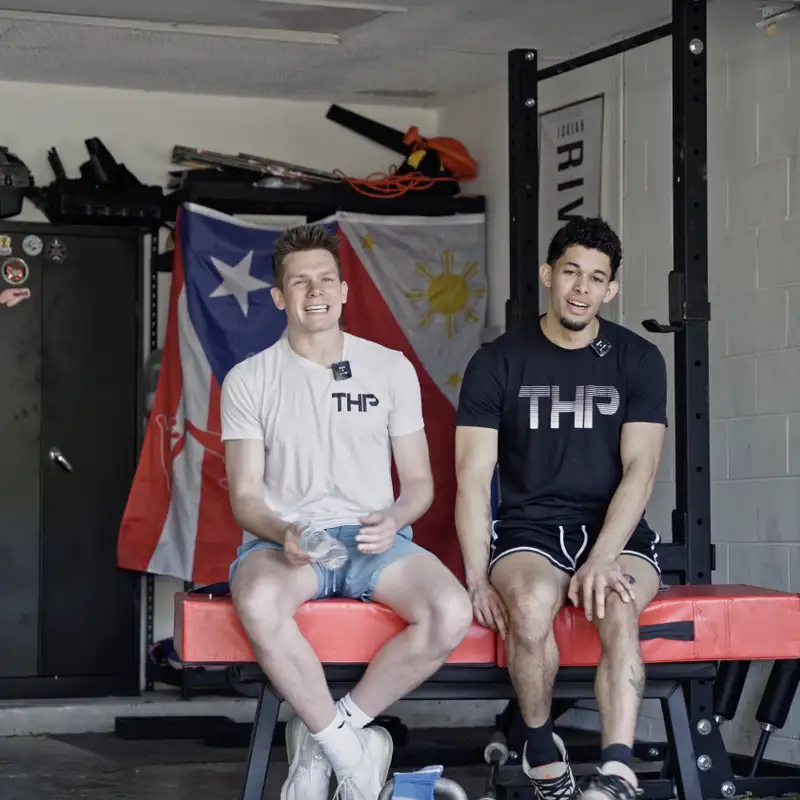
How deep should you squat?
Welcome everybody to the THP Strength podcast. Today's podcast is brought to you by our wonderful sponsor THP Strength. They are the premier company for jump training and getting rid of knee pain. So if you are somebody that is trying to jump higher, they actually have a guarantee going on that if you don't gain at least three inches of vertical in the next six months, they'll coach you for free until you do. They, meaning us.
John:I heard the owners are incredibly handsome, super talented. Yeah.
Isaiah:Yeah. Very smart.
John:Yeah. Very very intelligent. Very good at Listen to your needs. Listen to your needs, your wants, your desires, try to help you meet all those.
Isaiah:Yeah. Oh, yeah. But in all all jokes aside, we are confident that we will give you the best jump training that exists out there. And if you are ready and willing to work super hard to achieve your athletic goals, we will do our best to help you achieve them. Having said that, today's topic is how deep should you squat, which we actually shot yesterday.
Isaiah:It was like a forty minute episode that It
John:was twenty three minutes.
Isaiah:It was a twenty three minute episode that was not posted because the audio was messed up. So we're doing it all over again.
John:It's actually the third time we've done this now. Yeah. Because we did it once in twenty twenty yesterday.
Isaiah:I feel like
John:we've pretty
Isaiah:concise though. Yes. Now now that we've we did a practice run.
John:Yeah. That was a practice.
Isaiah:Yeah.
John:That was a warm up.
Isaiah:So I guess I will start by giving my experience with deep squats because
John:Wait. Did we introduce it? I forget. Did we actually introduce what the topic was?
Isaiah:I just introduced it.
John:Oh, okay. Okay. Yeah. Yeah.
Isaiah:So my personal experience with squatting, if you have seen any of my older videos oh, by the way, somebody commented on my video and they're like, tell him to to shut that stupid timer off.
John:I'm trying, but it literally doesn't let me. Every time my volume's all the way down. This shit's off.
Isaiah:The ringer, you gotta go in your settings and then adjust the ringer ringer volume.
John:For my timer app? Yeah. Not gonna happen.
Isaiah:Not for the timer app, just in general. It's the ringer volume. Ringer volume? Yeah. It's under settings.
Isaiah:Alright. I'll use it for this one.
John:Whoever is complaining about that, fuck you.
Isaiah:No. I'm playing. So, yeah, I was an avid deep squatter. My inspiration for deep squatting was Olympic lifting. I used to be obsessed watching Olympic lifters.
Isaiah:I would consider that one of my training backgrounds and inspirations in addition to watching Pro Dunkers. And, I squatted deep despite, although I had above average mobility, I still didn't have the body proportions required to deep squat without getting into butt link. One of the things we tell our athletes is deep or squat as deep as you can according to your flexibility. If you are going into butt wink at the bottom of a deep squat, I don't care what other people are saying. This is what we, training ourselves and training thousands of athletes and seeing what leads to injury and what doesn't lead to injury.
Isaiah:Along with what research Along with says. Yeah. Yeah. We do stuff based
John:on research. Even what we think. It's we verified what research says. If you're if you're
Isaiah:going into butt wink, that means you're not flexible enough to to deep squat, And you are going to be loading the spine really, really heavily to the point where it can cause injury. Specifically going it's compression from the bar being on your spine, and then going under flexion while in compression with a ton of weight on your back. So despite all that, I didn't know better. I forced myself to deep squat, and I had recurring back issues for a long, long time. I would be able to load up heavily for about a month, two months, sometimes three months at a time.
Isaiah:Back flare up would occur. I'd back off, and then I basically just repeated that process over and over again. They get stronger in a deep squat. Until eventually in 2020, it led to a very bad back injury that had me out and not training very hard for a lot of months, and I basically stalled my progress for about a year, year and a half as a result of that. This last year, I took out deep squats, started just half squatting, and it's the healthiest my spine has ever been.
Isaiah:So, yeah, probably never gonna deep back squat again. There is an argument to be made that spines can adapt. Our the stuff that we follow in terms of back research is Stuart McGill. One of the arguments against Stuart McGill's research is that his research was done on dead pig spines. You've actually spoken with with With Stuart McGill.
John:Yeah. Doctor Stu.
Isaiah:Yeah. Yeah. If you guys don't know who Travis Reynolds is, his Instagram is at travis dunks. He actually had a horrible back injury base basically because of the same thing. And then, yeah, he actually worked directly with Stuart McGow.
Isaiah:I think he did, like, two or three one on one calls with him, and he also hasn't had any back issues since then. He's gone back to doing East Bay dunks. Right now, he's trying underboth dunks. So back help is a whole another podcast topic, but our reasoning for not going into butt wink on a squat is you can run into back issues. We've seen it over and over and over and over again.
John:Yeah. Our reason because this is about deep squatting or squat depth, we have to cover that because that determines whether we think someone should or shouldn't.
Isaiah:Yeah.
John:Now when it comes to like the actual viability and efficacy of deep squatting in terms of research and everything else, typically, you're not gonna see a lot of deep squatting research. Reason being is most times they just say a back squat, and they'll define a back squat as the knee joint at 90 degrees, or they'll say the hips below parallel or however they do it. Typically, it's 90 degrees in the knee joint actually. A deep squat, they'll define as the knee at, I guess, a 130 degrees of flexion or something like But it's like basically below parallel. They do look at Olympic weight lifting, and they will look at the research related to that.
John:And so it pretty much indicates in terms of knee health, it is lower loading on the ACL. There's higher loading on the ACL on half squat, which is kind of interesting. And then they look at kind of all the other tissue and thing like things like that. I think the most prevalent research study though is the ACL one. A lot of people refer to that when they're trying to support deep squatting and things like that.
John:But for knee health, it pretty much I would say you don't need it. I think that it's important to get strong specifically for tenons in the range of motion that you're gonna be using in your sport. So, you know, if I'm a one foot jumper, I need to get good at quarter squats. It's a if I'm a two foot jumper, I need to get a good at half squats, probably don't need deep squats even. You know, like, Jill Cook and Ebony Reel, so you're just wasting time.
John:You you don't really need to do that. You know, you're just adding steps to the process. Yeah. You might increase your tissue resilience a little bit, but you're gonna be spending months and months doing that whenever you could have been doing depth drops or phase three tendon loading like I like to call it, or just stress shortening cycles. Right?
John:Actual jumping. So I think in in terms of rehab, you know, that kinda kinda covers it for that. For the meniscus, deep squatting is contraindicated. Right? So for cartilage, you're gonna see very high loading in the high pressure point positions.
John:So if you have chondromalacia or you have a meniscus injury, deep squatting is gonna fuck it up. And then quarter squatting really heavy is probably gonna mess it up too. So you don't you know, you wanna avoid those two end ranges and kinda be in the middle, or the pressure between the kneecap is really high for chondromalacia. And then for the meniscus, it's actually mostly just deep squatting. Because that's where it's just contraindicated in research.
John:We see time and time again that it is going to flare up the meniscus. It's gonna cause problems, and it can ultimately lead to an increase. Is he gonna hit that car? He's See how close he was? Yeah.
John:Oh, I'm glad I didn't park there. So, yeah, I think that it's can be good for tendons, I guess, if you can handle it. Like, you don't go into butt wink, I think it can be good.
Isaiah:I will say anecdotally For
John:for guys with the distal tendinopathy, I think deep squatting is Yeah.
Isaiah:Really good. A anecdotally, when I've been strong and pain free in a deep squat position, I tend to have less tendinopathy issues. But you have more
John:back issues.
Isaiah:Yeah. It's a trade off. Well, that's where it fronts. I have enough mobility.
John:Which tracks? I mean, if you're talking just about tendons, that's gonna be one of the highest loaded positions. You're in the worst leverage and you're in the most compression. So if you don't have pain in that position, you're probably gonna be pretty healthy. You know?
John:You're probably gonna be able to handle a lot. But that's further along down the continuum than you might even need to be to be jumping healthy or doing performance training.
Isaiah:Do think it's like a weird medium as specifically talking about knee pain. It is I think the reason being is I I do agree that you don't need it. It's just easier to control the loading versus like Yeah. Versus if you're jumping, like, guys usually don't have self discipline when jumping and stuff like that. But if you're careful about your elastic loading, you don't need to get strong as hell in a deep squat
John:position. So then I I think the other one would be. For Go ahead. Training purposes. Was just gonna for
Isaiah:training purposes. I was actually gonna I was gonna I was gonna give you a hypothetical scenario that I think will explain training purposes. You have an athlete who has mobility to deep squat. K. Explain the progression of them squatting.
Isaiah:How deep would you have them squatting? At what times are they gonna be doing certain types of squats?
John:Okay. So they're healthy? And they're healthy. Yeah. They're healthy.
John:They can deep squat. Yep. So they come to me. They're healthy. They can deep squat.
John:What's their vertical?
Isaiah:37, 38 inches. Two foot Two foot jumper. They they can deep squat three fifteen.
John:Okay. So I'm definitely gonna have them deep squat. Probably gonna have them deep squat a lot. Early in the year, they're gonna be doing really high volume deep squatting. I'll probably keep it in year round, but the frequency of the deep squatting is gonna change.
John:So Fridays for guys like that, typically, Fridays or Saturdays, I'll put in either some sort of loading or I'll put in slow deep squats. If they're a two foot jumper and they're really healthy, I'll probably put it on Saturday and have them jump on Friday. But that fry or that last third high intensity session in the weight room, if it is high intensity, I will try to put full squats in anywhere between six and I mean, it could be as high as 10 really early in the year. So we'll say between ten and five reps, maybe four on that Friday session. And and the reason I do it on the we'll we'll call it Friday or Saturday.
John:We'll call it end of week session. The reason I do that is because I like that day to usually stay as a I don't wanna call it inertially focused. I'll call it like strength speed, strength stimulus, kind of absolute strength stimulus. The reason being, I never wanna get too far away from that. Because one, it's really hard to load deep squatting in season when you haven't been doing it, because it causes immense immense amounts of soreness.
John:Typically in the adductors, guys will get very very sore in their hips. They'll get really really sore too. So I don't I don't really like to ever take it out. I always wanna keep it in at least a little bit. Early in the year, they're gonna be doing higher frequencies.
John:So maybe they'll do twice a week or three times a week between front squatting and back squatting. Maybe between six and twelve to 15 reps. If it's a six month macro cycle, typically, we guys see macro cycles are a year, but they don't have to be. They can be any length of time. You can split it up however you want.
John:In this case, we'll say a six month macro cycle. Month two, probably gonna start building into lower rep schemes. So maybe that, like I don't know, eight to three. And then I'm gonna start playing around, and those are gonna be full squats as well. And then I'm gonna start playing around with tempos and different types of of tempos or pauses in deep squats if he can do it.
John:Probably about three months out from when I want him to be jumping high, I'll probably cut the frequency to once a week, and that's about it. Reason being, I wanna get more specific. So when I'm three months out, probably be doing, you know, some form of heavy half squatting, maybe building tempos into the deep squats at three months out, depending on the athlete. Maybe I would be doing isometrics or eccentric work close to maximally. Two months out yeah.
John:Probably three months out, I'd be in, like, special prep. So they'd be doing a lot of specific work in the weight room. Two months out, they're probably gonna be doing either fast eccentrics or super super maximally eccentrics. One month out, and those would be in partial ranges of motion. One month out, they're probably gonna be in the last three months, we'll say they're deep squatting once a week.
John:Probably still the same, not very heavy. Just maintaining that quality because I think it is helpful and useful, but that's not where most of the loading is gonna be. That's not where the that is there to maintain tissue quality, I would say, and your ability to produce force over full ranges of motion. Right? If you look at any athlete who's really, really explosive in their activity, they typically can produce a lot of force over big ranges of motion.
John:Does that mean a full squat per se? No. Most people don't need that level of explosiveness across a full range of motion. And so I'm not typically gonna be pushing that up or using that as an explosive explosive strength or speed strength stimulus or strength speed stimulus. I'm not using full squats as a as a a means of achieving that goal.
John:I'm using it for a max strength stimulus. I'm using it for a way to improve hypertrophy. In some cases, maybe we see the nervous system get some positive adaptations because you're moving a heavy weight over a big range of motion. Maybe you have some some tendon hypertrophy or cross sectional area proliferation, meaning like the tendon's getting bigger and thicker. We have more tendon tissue.
John:Maybe that's benefiting the stiffness, which if the athlete gets more explosive is really helpful. But, yeah, that that pretty much be, I guess, how I would how I would integrate them. And then if they can't deep back squat, I'll usually have them deep front squat, which is what we do with Isaiah. So I try to keep some deep front squatting in each cycle. Either that or I would put in some other full range of motion knee exercise.
John:It doesn't have to be squatting. I just want the the quad to be loaded across the full range of motion and the hip to be loaded across the full range of motion.
Isaiah:How would you progress somebody that doesn't have the mobility to full squat? Like, let's say you can only half squat. Is there a way that you go from general specific as far as joint angles or is that kinda like I still would. Too, like, tough
John:tough So if if so if it were a two let's say like me.
Isaiah:Right? Yeah.
John:This is like me in my case. So if I'm let's say again, it's the same six month example. Six months out, I would do leg extensions. I would do knee extensions. Because I can get full range of motion in that activity.
John:I might do a hack squat, or I might do a single leg leg press. Any way that I can do full range of motion, I will. And then five months out, you'd follow the same progression. Right? Would I keep that in year round though?
John:Probably not. I probably wouldn't because it just gets too difficult to have that be as I don't want that being a staple exercise. I don't want a leg press, single leg press or a a knee extension being a staple exercise. Yeah. I probably would be okay.
John:I mean, I can half squat decent decently well. I'd probably be fine with that being a staple exercise in the program on that, you know, third day of the week throughout the year, but it's pretty much always gonna stay as a feel good lift in that scenario. So if they feel better, like in my case, I feel pretty good doing a leg press, but I don't have a leg press here. And I don't a leg extension here. So I'm probably gonna do, you know, I'm not gonna do a sissy squat.
John:That's probably gonna be way overloaded for a deep knee. First off, it's not even a deep knee flexion exercise unless you're Yeah. Touching the ground. I don't really like reverse Nordics because they don't really address the hip. That's another reason why I don't really like And
Isaiah:it's hard to load.
John:It's really hard to load. It's kind of unsafe. You put a lot a lot of stress on the joint actually by getting that far out. For this is not I've never really seen it work for tendons too well. Yeah.
John:I'm not actually not seeing it work for joints in general.
Isaiah:I think leg extension and leg press is probably
John:Those would be the ways I would get deep knee flexion. Like, if you had those, I would be fine doing those once a week. Yeah. The only thing about specifically leg extension is it does put a lot of compression on the joint, Especially, we need the kneecap pulling in. I would be totally fine with I would love Yeah.
Isaiah:Get a leg press and a leg extension. Space,
John:dude. It's gonna look like No.
Isaiah:So what I'm thinking, because Marissa's gonna move out soon, Put all that stuff. That's the storage room.
John:Okay. I like that. Like that. That could work. That could work.
John:I would be down for that.
Isaiah:Alright.
John:So, yeah, I I think that that's probably how I would do it. Everything would stay pretty much the same in that case, but I would just get a different deep knee flexion exercise or feel good lift to maintain that quality. Yeah. But typically, even if you couldn't deep squat, you can still maintain your strength levels. I mean, if I can't get in that full range of motion in squat, I sure as shit am not getting it in a jump.
John:Yeah. So as deep as I'm getting in a squat, that's probably the max range of motion I'm gonna hit anyways. You're not getting the overload that you get maybe from a full range of motion squat, which the benefit is you're loading it at length. A really good stimulus for muscle hypertrophy. It's a really good stimulus for the nervous system because you can push so long over a full range of motion, and it really is just a a different level of hard, which I like, that you don't really get in even half squat in my opinion.
Isaiah:It is like I mean, I think even because I haven't we haven't done front squats in about two months.
John:Mhmm.
Isaiah:And this this cycle, we reintroduced them on Monday. And I mean, I did two seventy five for sets of six, and it was tough. And it is a it's like a different type of hard. Like, I I think about my half squat four twenty five for six, and that was crazy, but then it's like, it just it just feels different. It's hard.
John:You can just it's a really
Isaiah:difficult I would describe it as the half squat feels like I'm like, nearly messed up after it. And it's just like muscular. And it's like on my core and everything. It's like a lot. But, yeah, the the deep squats are just muscularly.
Isaiah:Like, I get like a crazy ass pump Yeah. That I don't get from anything anything else.
John:Yeah. Which I which I think is why you get so much hypertrophy from it. Yep.
Isaiah:I think it's really, really good. That's how you that's how you big old things
John:like drumsticks. So I I think yeah. That's pretty much how I would do that. I think we covered injury. We covered performance.
John:The only other thing I'd say that I really like about full squatting is that it is a great equalizer if you if you normalize for limb length. So like a lot of the times, you would be like, well, you know, someone said this on your video the other day. Well, I squat this and how come I don't jump that high? And I'm like, well, are you six two with long tibias and long femurs and is your deep squat the same as his deep squat?
Isaiah:Every time I see that comment, it's like a five nine guy.
John:Yeah. Yeah.
Isaiah:It's like every time every time I see somebody say
John:With short
Isaiah:your weight. Every time I see somebody say, hey, I squat the same as you or I lift the same as you and I'm your weight. Why don't I jump as high? Every like nine out of 10 times, I go in there and it's like a five nine. Like, Uber is like stocky.
Isaiah:And then
John:But it's not the same. And then It's not the same.
Isaiah:And then the one, like the rare, 10% of the time where someone that's actually similar to me, it'll be like a like a cross fitter or something that The strongest. That does no jumping.
John:That does yeah. That does no jumping. Zero jumping and does not have necessarily the same body mass. I don't think the body mass is the same in that case. Actually, the two Those guys are way heavier.
Isaiah:You know who the two athletes that I see that I'm like, okay, similar proportions, same weight room numbers, and
John:Don't jump as high?
Isaiah:No. No. No. Like, same same weight room numbers, all that stuff is Tief Line High and Jay Park the jumper, who are also two near 50 inch vertical.
John:Yeah. I mean, CrossFitters are probably the ones that get close, but they just don't jump. They have horrible jump technique. Their tendons are usually incredibly stiff. Super freaking stiff.
John:We talking about that earlier? Yeah.
Isaiah:Those guys And ton of upper body.
John:But they don't have any RFD. They don't have any RFD. Like like on top they have RFD. Don't get me wrong. They can power clean a lot of weight, but it's not the same.
John:Like, they don't have Well, it's elastic RFD.
Isaiah:Levels to that.
John:Yeah. There's levels to RFD, and there's elastic RFD where it's like fast eccentric loading. They're shitty at fast eccentric loading. Yeah. Really bad.
John:If they did it more, probably be really good. We coached a couple of guys RFD 40 inch verticals that like like the the the brothers that we used to coach Yeah. That were like that. Their RFD in really fast stuff was not very good. Like, they could get stronger and stuff like that, but it was like, they'd be better off doing things that would improve their RFD more, and usually they weren't healthy enough to jump as much as they probably needed.
John:Specificity.
Isaiah:Yeah. They CrossFitter, how many times
John:were they power cleaners? They were too big too. Way too big. They needed to be way leaner. So, alright.
John:Did that cover it?
Isaiah:Yep. By by the way, RFD is rate of force development. Yeah. If you don't know what that is. I'm trying be good about
John:Nah. Finding actual They just have to be smarter.
Isaiah:No. I'm kidding.
John:Alright. Well, thanks for listening to the video or this podcast, guys. If you're on a streaming platform, make sure that you give it five stars. Subscribe if it's an option. If you're on YouTube, like, comment, leave us some feedback.
John:If it's negative feedback, I'll usually listen to what you're saying, but I will I
Isaiah:actually like negative feedback. Or if think
John:we're wrong. Plain about it, but I like to hear
Isaiah:it. Especially Or if
John:think we're wrong.
Isaiah:Yeah. Yeah. If you think we're some of my biggest learning experiences this year have been
John:When people
Isaiah:When I'm wrong. Because because when somebody tells me I'm wrong, I go and read I pull up Google Scholar and then I go down the road.
John:I take it personally, but I also learned from it Yeah. Because I took it personally, which is always really good. So keep that in mind, give me a week to think about it and, you know, I'll come to my senses and be like, yeah, you're probably right. Yeah. Which is Like,
Isaiah:I I got into an argument with somebody yesterday. It was about our video, our last podcast. About what? They said that we titled it wrong because we said, which one's better, max strength work in jumping or max strength or strength training plus power, something like that. And they got me on a technicality.
Isaiah:They were like, they were like, oh, max strength work. There there's other ways to do max strength work, like, shouldn't be called just strength training. It was something like that. Basically, I defined it wrong and I was like, okay. You can have Technically, that you're right, but
John:I don't even know how
Isaiah:to say that. I I I'll have to I'll show you after this,
John:but Yeah. Let me let me just say this. If you thought that appealing to the masses or if you thought that appealing to that very small niche nuance is gonna be beneficial for your online business, you're fucking wrong. But, hey, you you can get technicalities if you'd like.
Isaiah:I do I I do appreciate that stuff though because I do think that defining words is very important.
John:Defining words only because you had one bad experience with coaches saying elasticity and ever since then, you've No.
Isaiah:It was a force velocity. Force velocity.
John:Oh. That's where it started. Yeah. That was bad.
Isaiah:That was where it
John:really But it made sense for you over time. Eventually, it Anyways, caught like I said, if you're on the YouTube, leave feedback, comment, like, subscribe to to my channel, subscribe to his channel, and
Isaiah:Especially if you're a THP athlete, the least you can do. Yeah. Leave a five star on information. Like, what the hell?
John:Anyways, peace out guys. Know, see you tomorrow.
Isaiah:Crazy, John. What? I remember when you were on a podcast in 2018. You you can keep this in.
John:Oh, yeah. What was it?
Isaiah:I remember I remember when John went on a podcast in 2018, and I listened to it. And I was like, damn, I could listen to this all day. I probably listened to it like three or four times. I forgot who had you on. Steven?
Isaiah:I think it was an Australian guy who had you on on their podcast.
John:I don't remember who it was.
Isaiah:It was definitely an Australian an Australian guy. It was like a like a
John:Oh, is it Oscar?
Isaiah:Yeah. Yeah. Yeah. Yeah. Oscars.
Isaiah:Yeah. And then I remember like, damn, like this is so informational. And now the fact that you're on podcast every day, I would be mind blown. If it if it was 2017 and I had this info, I'd be mind blown.
John:Wait. Was I on that before I started coaching you?
Isaiah:It was around the same time. Like, it was like it was actually be so you healed my knees and then like
John:Oh, it in that off? In between.
Isaiah:And it was it it that podcast was actually one of like the reasons because it was like that podcast happened and I went home and then and then Austin was like, look at my training. And I was like, alright. Let me can you ask John? Will he take me back? Yeah.
Isaiah:So
John:Glad I did. Yeah.
Isaiah:Worked out for both of us. Having said that, if you find any value, like the video, share it. It's time for your q and
John:a.
Isaiah:Peace out. Damn it.