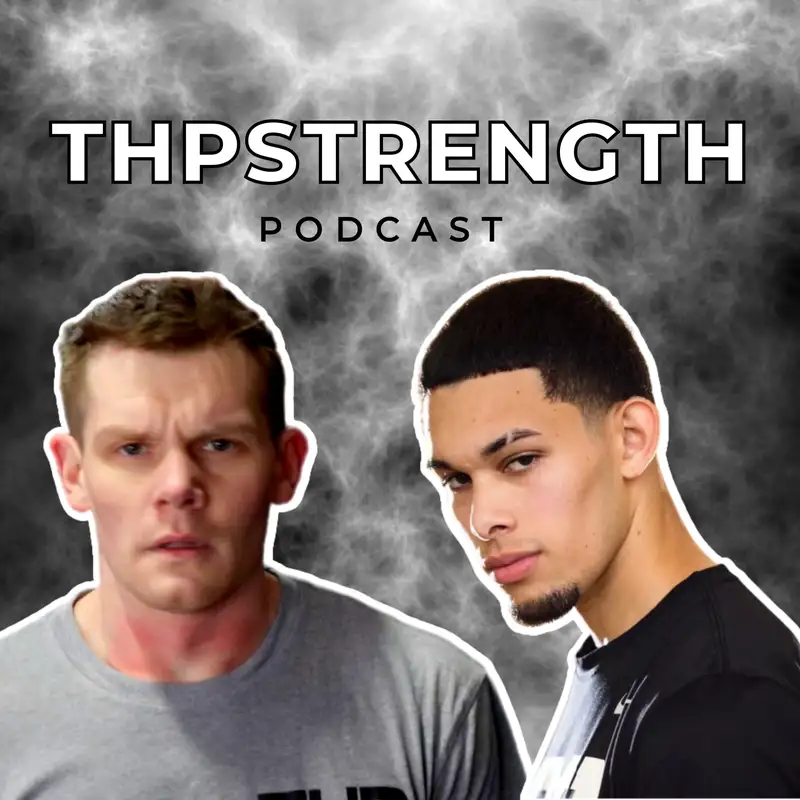
Biggest Mistakes We Ever Made
What's up, everybody? Welcome to the THP Strength podcast. Today, we're gonna be talking about mistakes that we've made in our jump training careers. Why should you listen to us? Because I jumped really high, and he coaches me to jump really high.
Isaiah:Specifically, he coached me to have the highest vertical on the planet.
John:That's a little bit pitch. Yeah. You do the pitch. I'm done doing that.
Isaiah:Whoever talks shit, this is your fault. You guys bullied John. That is Bullying is bad.
John:Cyber bullying. I decided because of it, I'm raising the price to something infinitely high.
Isaiah:Yeah. THP is now gonna be $9.99 per month. Yeah. Just kidding. It's actually only $99 per month.
Isaiah:If you wanna go sign up, go to THP's training program.
John:$9.99, like, dollars
Isaiah:and 99¢ per month. That's what the price is gonna be. Okay. Alright. Yeah.
Isaiah:All jokes aside, go to t'sspeechstrength.com if you wanna get coached by both of us. John's actually a nice guy.
John:Thanks, man.
Isaiah:He might seem like a dick, but he's not.
John:I told Andy the other day. I was like told my girlfriend. She was like, why are you such an asshole? And I was like, I am an asshole. Yeah.
John:And I was like, I don't know why.
Isaiah:But look. He's an asshole that can make you jump higher.
John:It's because I care. I'm an asshole who cares. Yeah. That's what I would actually say. I care a lot.
John:That's why I am an asshole.
Isaiah:So put your feelings aside. Let yourself Let John talk shit about your dumb technique.
John:At least it's honest. Yeah. Yeah.
Isaiah:Yeah. He's an honest asshole.
John:Just want you to be great. I just want you all to be great.
Isaiah:I'd rather have an honest asshole as my coach than Than a kind buddy. Than a than a nice fake person.
John:Yeah. Exactly.
Isaiah:Than a nice fake person.
John:I mean, I I do believe in, like, you know, building a relationship, but it's like you gotta have it's like children. You gotta have an authority to you know, and and Yeah. Boundaries and standards, and then you also have to have a existing relationship. I have both. It's just that the sarcastic asshole side Yeah.
John:Happens to come out a little more forgiving and helping.
Isaiah:And there's nothing wrong with pitching our services. You know what I mean?
John:That's what we do. Here he is. Austin's late. Too bad. We started
Isaiah:the podcast, Austin. But, yeah, go sign up if if you're interested in coaching or just use our free tips here. But if you do like the video, helps push it out to more people.
John:Alright. That said, we are gonna be talking about the biggest mistakes that we've made in our careers as athletes and jumpers. So you can go first. I know what my first one is. Do you know what your first one is?
Isaiah:Yeah. Yeah. Yeah. Go ahead. My first one is letting injuries get too bad before doing something about them.
John:Our friend our friend Austin has a risen has a risen.
Isaiah:We're talking about mistakes we wish we could take back.
Speaker 3:What is that? We should give them a discount.
John:No. It's too late.
Isaiah:It's too late. You've already
Speaker 3:missed it. You're right. Wow. Are you ready to go crazy? Are you ready to change your life?
Speaker 3:Are you ready to wake up every morning a little bit sore but content with your progress? If you've been weary, sign up for your for THP at thpstrength.com with code THP for your 10% off your first month. It's worth it.
Isaiah:And if you're just gonna be a one and done, we don't want you.
Speaker 3:No. We we like
Isaiah:Because one of the mistakes that I wish I had never done is stop training.
John:There is a time where Isaiah did betray me. No.
Isaiah:I'm just kidding. No. No. No. There's actually there's a
John:period of time where he And stopped training with is that what you're talking about? No.
Isaiah:I stopped. I didn't train for a year.
John:What? I went. Jumped. Oh, yeah. But that's still kinda training.
John:Not really. But but, yeah, actually, talk about that as a mistake because that is relevant.
Isaiah:Yeah. Talk about the trail. I made a lot of progress lifting for about two years. And then one year, I was like, I'm gonna take a year off of lifting. And my vertical went from probably, like, 44 to, like, 40 or 39.
Isaiah:And I ended up being very, very injured, and I have not stopped lifting since then. So that's my first mistake. Don't stop. Stick to your training.
John:Your turn. Advice. My turn? Yeah. I definitely did not jump enough as a kid.
John:That was my biggest mistake. I probably if I could go back, I would have stuck with two foot. I would have low rimmed a lot when I was in, you know, middle school and just had fun. I probably would have stopped being so obsessed with, like, trying to get a, you know, a college scholarship or trying to be a track and field athlete. I would have just done what was fun, and I would have enjoyed the process.
John:I think I was so focused on being a successful track and field athlete or being a successful, you know, whatever and and it ended up meaning nothing. I didn't compete in college. I didn't get a college scholarship. It did make me a good coach. But as an athlete, if I wanted to go back and do it again as a jumper, I would've jumped.
John:I would've gone outside when I was 14, not done, you know, these programs that didn't work. That was the other thing I would say is I would I wish I wouldn't have wasted so much time on stuff that didn't work. I wasted so much time on stuff that didn't work. And that's partially why
Isaiah:What stuff, Like, didn't work.
John:I did jump manual. Didn't really work. I did a little bit of air alert actually. Didn't work. Vertical jump bible.
John:I think vertical jump no. That's the one you did. Right?
Isaiah:Yeah. Yeah. Well, I read it. I read it.
John:You read it. I don't think I did that.
Isaiah:I read it every program and didn't do them. I was like, I'd rather jump.
John:Yeah. I did I did what else did I do? I did power plyometrics too many times. I wish I would've just done it once and then dunked. I wish I did less plyos and dunked more.
John:And then I did a lot of strength training that was in organized, inefficient, and actually ended up hurting myself. So that was the other thing too that I wish I would've done is listen to know what it meant to listen to my body and how to do it. Like, I had no idea what I was doing. I just thought squat more better, power clean more better, calf raise more better. And then I ended up fucking up my back into absolute oblivion.
John:I remember I was deep squatting. It was the winter break. I was 17, was at a retreat, and I was lifting in the morning, and it said deep squats on the program. And I just was like, program says deep squats. I'm gonna do deep squats.
John:My coach at the time was Mike. Mike was not watching my workouts. Never sent him videos. I just did the workouts to a t. But, yeah, I squatted, got down to the bottom of a squat.
John:Of my half squat, it was like a 100 per it was like my I can't remember what the number was. It was like 85% of my back squat, but deep squatted. And I got down and my pelvis rolled under and I just remember I stood up and my back just like felt this sharp stretching pain and I like couldn't walk for a couple days. And I remember thinking like, oh, that's it. My career is over.
John:And I ended up getting better and being fine, but I wish I would've had someone to guide me through that process. And that's why actually THP exists is because there's so much misinformation out there that people don't know what's real and what's not. It's not a it's not a lack of information. It's just that there's so much information, it's hard to decipher what's real. And now we have AI that thinks it knows, and it's even wrong.
John:Like, it's so difficult to find good training information that you know is robust and you know is practical and and research backed and is evidence based as well as time tested, which is why, again, I I wish I would have had someone that knew what they were doing and was able to guide me through that process.
Isaiah:And what's cool is that it's like we've bridged the gap between, like, good training and then how do you apply it to dunking.
John:Oh, yeah. Yeah. That wasn't even a thing.
Isaiah:Because there was good training and there's research and stuff like that, but there's no research basically no research on two foot jumping, no research on improving dunking specifically. It's such a niche thing too. It's like a it's weird because it's like dunking is actually really coveted. Like, so many people wanna do it because of basketball. But then it's also hyper niche because, like, the people that actually only wanna dunk not for the sake of basketballs is is a really small amount.
John:Yeah. I definitely
Isaiah:agree with that. But, I feel like we've done a good job of connecting connecting those two dots, which is cool. And we if we had that, like, imagine we had, like, the information we're putting out at at 14 years old.
John:Dude, crazy to me though is that, like and this is maybe gonna sound bad, but it's like, why why do other people go other places? That absolutely baffles me. That has baffled me since 2016, 2017. People will be like, I'm gonna do it on my own. I'm like, good luck.
John:Every single person that has done that
Speaker 3:We've both done that.
John:Has not is either not improved or come back.
Isaiah:Yeah.
John:Like Yeah. I remember
Isaiah:Shiny objects in there.
John:Or or they just don't wanna train. They just don't wanna train. And it's like, do you know what it takes to actually be great? What?
Speaker 3:Is that shiny object?
Isaiah:And then he looked at me like.
John:Oh, yeah. I wonder why.
Isaiah:Like shiny things.
John:Alright. Austin, go ahead. Your turn.
Speaker 3:Training mistakes?
John:Training mistakes. Biggest mistakes you made.
Isaiah:Biggest mistakes
John:you made. And, like, if you could undo them.
Speaker 3:Okay. So I was a little bit of Isaiah and a bit of John. So I did take breaks in my training where various trips and just lifestyle stuff. And then I also did every program growing up. So one of the biggest things I would say that mistakes I made growing up was doing too much.
Speaker 3:So I was dunking every day and I was doing every program under the sun.
John:At the
Speaker 3:same time? At both. Yeah. So I think it's it's funny because you were doing all the programs. You were doing all the jumping, and I was over here doing both.
Speaker 3:I would just I would do less. Same same thing later on in my life with upper body. Was doing way too much upper body. It's it's, finding the balance in doing what's required and just trusting that it works as opposed to just trying to do everything. And when you do too much, you just you explode.
Speaker 3:Yeah.
John:It sounds like you fell prey to shiny object syndrome.
Isaiah:Like, the You were. Like, you were, like,
John:the extreme of You were the extreme of
Speaker 3:I was jumping every day.
John:You literally were like you were like, oh, I heard this thing works. I wanna buy that program.
Speaker 3:Every day.
John:And I heard this program works. So I'm just gonna stack that on top. Like, more is better. Like, it's like, if this thing works and this thing works, I'll just do everything until my day is four hours long of every single program.
Speaker 3:Basically. Another thing is too is is stick to the stick the course. Like, don't try something out for a week. And if it's not working, go to something else. Just ride it out and go through it all.
John:You still struggle with that.
Speaker 3:I do struggle with that still, but I'm getting better. I think being having you guys both here, like, yelling at me and hitting me every day, like, really helps.
John:There's a lot of punishment that takes place in your life. There's a lot of punishment of, like, don't. It's not even punishment. It's like a positive feedback and negative feedback, you know. And some punishment.
John:Yeah. There's some like hitting involved, some pain, and when then it's like, or I guilt you. I use different strategies.
Isaiah:Guilt me
John:a lot. I use I use unhealthy relationship strategies that you should never use with your partner on Austin because I know it'll work more effectively on him. He can handle it.
Speaker 3:Yeah. I'm a I'm a trauma baby.
John:That's a joke. I'm a trauma baby.
Isaiah:I I think a lot.
John:I'm like I'm trying to think of an example of of when I've done this to you. I just guilt you for bad decision. I guilt both of you when you make bad decisions. I try to make you feel as bad as possible for doing it. When they dunk when they're not supposed to, I just guilt them.
John:I'm like, wow. I can't believe this. I'm so disappointed in you.
Isaiah:You know what John said? I could do a right
John:left session thing? I did not say that. What? I actually He was a jealot. I did not say that.
Isaiah:Dude, that's so was so happy.
Speaker 3:And we used gaslighting on John.
John:Don't gaslight the shit out of me. Yeah. They they think it's hilarious. And then I go home and I'm like No. Stabbing my eyes out.
Isaiah:Did did I tell him?
Speaker 3:The the difference between me younger I mean, now though, is when you guilt me, I actually feel bad. Before I'd be
John:like, he didn't know what he's doing. He didn't feel any vertical. He didn't know about it.
Speaker 3:Alright. That said, I feel like that
John:is is that adequately covered, Isaiah?
Isaiah:Yeah. I was I was gonna think a good spot to end it is, like, it all comes down to falling in love with the process Mhmm. Making the work the goal, and just, like, yeah, just genuinely enjoying training itself. Yeah. And if you can fall in love with the process, you will go a long way.
John:And obviously, we want you guys to be to be great and be successful. We believe that we're the best of what we do. We try to give you guys and especially if you're one of our current athletes, we do our absolute damnedest to give you the absolute best that we can every single morning. We get on and we try to help you guys be great. Now if you're discouraged because you're not like jumping a certain height or you're not where you think you should be or you're worried about if this is the right decision for you or this is the right path, I can, with 1000% certainty, say there is no better place for you to direct your time and energy than working with us.
John:But you have to stay the course. You can't like, if you fall into this process of, like, not buying into it, it's game over. You're done. You're never gonna be successful. You're gonna keep jumping program hopping.
Isaiah:And Also You're not gonna
John:be successful as an athlete.
Isaiah:Also wanna add this?
John:Not even my opinion. That's fact.
Isaiah:Yeah. Also, I I wanna add this. You have to, like, enjoy it too. I think a lot of people try to force, like, passion, if that makes sense. Mhmm.
John:Dunking should be fun. Yeah. Dumping high should be fun. It is fun.
Speaker 3:And it's fun. The training can be fun too. I the training can be fun. You just have to I don't know.
John:We joke it sucking. It's fun.
Speaker 3:Make it part of the day. Like, that's that's one thing you and I always talk about. It's like train we don't we don't like hype ourselves up to go workout. We're not like, oh, we gotta work out. I'm going to the gym tonight.
Speaker 3:We we go to the gym six days of the week or we work out six days of the week, and it is part of our lifestyle. Same as using the bathroom or eating. Like, working out is part of that. Like, if you play an hour video games a day, like, it's a routine of our it's just a routine. Make it a routine.
Speaker 3:Make it normal.
Isaiah:The thing is you have to embrace that there's a saying the marines have embrace the suck. Embrace the suck. And, like, the training double. Embrace like like We got that. The training, like, training is really difficult, and it's suffering.
Isaiah:And I genuinely enjoy suffering. Like, even though I sound like a masochist saying that, like, I'm just like I just like it. I think there's something cool about going through something extremely difficult. And, like and then what what the magic starts happening when it becomes a habit to go through difficult things every day. Yeah.
Isaiah:Like, I think that's David Goggins' whole thing is that is, like Mhmm. Do something difficult every single day, and eventually, it becomes who you are. And that's what separates people who, like, achieve actually great things in life versus people who are just, like, the neck beards in their mom's basement is, like
John:Do hard stuff.
Isaiah:Yeah. You do hard things every single day, and it becomes really enjoyable.
Speaker 3:And we're not we're not saying give up everything that you enjoy doing. We're saying an hour and a half, two hours a day, you can end up Even shorter. Version of yourself. Yeah. Like, honestly, shorter.
Speaker 3:Right? This is on the high end.
Isaiah:Like, something, something in our training because, obviously, everybody has lives. You have school. You have jobs. You have families. Like, we have this thing in our in our frequently asked questions, how to easyify the workouts.
Isaiah:And you can make the workouts take thirty minutes, technically. But I think as long as, like, once a day, you do something that's difficult and you get through it, you know, like, you you'll go a long way. It'll take longer, but you're still gonna make a lot of progress, and your your brain's gonna get stronger, and it'll be good.
John:And you you have to build the habit too. And this is, like, the last anecdote I'll give. When I was in high school, there was, an athlete. His name was Eric Broadbent. He had finished four years of college.
John:At the time, I was under the assumption. Once you're post college, you're you're at your genetic peak peak, you're not gonna get better. You're not gonna improve. After that, it's done. Right?
John:And so Eric had this dream of being an Olympian. So he was like a 6,900 decathlete or something at the time. To go to the Olympics, he needed almost 8,000 points. He was already amazing at a ton of events. He had incredible training for three, four year or maybe more, five years.
John:And I remember thinking like, he really, like, after all those years of training, at this point, maybe had a training age of like eight years or something. He was further along than I was even. And he or maybe I had four or five years. He was like eight years in. And I'm like, there's no way you can continue to get better.
John:And he just slowly, every single year, got a little bit better, a little bit better, a little bit better. And I was like, this is shattering my belief of what your genetic potential is and how long it actually takes to get there. I realized at that time, at that moment, that you can be way, way freaking better than you ever thought if you just stay the course. Like, I saw him go from six two in high jump to seven foot.
Speaker 3:That's
John:great. And I could not believe it. I was baffled. It might have been six four to seven foot or seven one. And I was like, how the hell post collegiate did you improve your high jump by eight inches or 10 inches or whatever?
John:Like, that makes no sense to me.
Isaiah:I have I have one really similar anecdote. I was I was thinking about this the other day. The year where you started coaching me, got my knees healthy. My vertical went from, like, 42 to I think I tested 44.5. That was 2018.
Isaiah:That was exactly six years ago. Forty four forty four point five, and that was a similar. Was I think I was 21. It's, like, technically, like, post, like, end of like, Yeah. The equivalent of a senior senior in college or junior in college.
Isaiah:And you've been training a lot. Yeah. I've been training a lot. And that is an impressive vertical, but it's not, you know, point o o 1%. There's a lot of guys with 44 inch verticals on in the planet.
Isaiah:And then now possibly having the the highest vertical on the planet. But if you take it out, I went forty four five to 55, it took six years. That's one inch per year.
Speaker 3:Yep. That's crazy.
Isaiah:When you when you zoom in, it's not very impressive, and it's really boring. There's a lot of plateaus and stuff. But then you zoom out six years, and it's like otherworldly progress. It's like very difficult to do that for an athlete. So, yeah, it take it takes time.
Isaiah:And, the only way I think you can make it through a process like that is by enjoying the process. Like, you just enjoy the little things and try to do the little things really well each day and, like, zoom out for a long enough time, it becomes insane.
John:You have to see the big picture. You don't know in a year. If you even just stick with a year like, once you get that year in
Speaker 3:Yeah.
John:You could be maybe like for me, for example, right off two foot. Right now my vertical is maybe what? 34, 35? Like in a year, I might be Right? Eclipsing And then the next year I might be 41 or 42.
John:The next year I might be forty three, 44. What you don't see or what you don't realize is that just the difference between those is me barely making a one hander to in two years being one of the better dunkers in the country off two feet. At a 44 inch vertical at my height, I'm east bang on 10 feet. I'm elbowing on 10 feet. Like if you add eight inches to my vertical, I'm elbowing and east bang on 10 feet.
John:I've never done that my whole life. That's two years away potentially. Might be more, might be less, but or it's like tomahawk two handers. It's a way it's a different ballgame. You're in a different you're in a different stratosphere of athleticism.
Speaker 3:Yeah. I I think another thing is to, like, if you zoom in, like, I've been plateaued for a while now, like, since my peak at 2022, like, it's all a process. And I think, you know, you just gotta keep going. It can get know, disheartening and whatnot. But You like it.
Speaker 3:I do like it. I do. I do. I like training. I like it.
Speaker 3:One thing too is a mental benefit. I would say, there's something Joe Rogan said years ago, and I can't I can't remember. You know you know the one podcast where he talks about kinda like and we always joke about it, like, releasing the demons. Yeah. And it helps with anxiety, working out, and really pushing yourself to that point of survival mode really helps with your anxiety, your confidence, everything.
Speaker 3:And it just makes life more present. It just allows you to be in the moment more. You know you know what benefits of that.
Isaiah:What's wild too is, like, you're as you, like, become more advanced, like, what you gauge progress and what's normal, like, completely changes. Like, if you take a a 15 year old Mhmm. And then he's like, like, a month went by and only increased my vertical by an inch. Yeah. And then now, like, just hearing you say that, like, it's been, like, a a two year plateau or whatever.
Isaiah:And then I was just like, it's pretty normal.
Speaker 3:Yeah. Yeah.
Isaiah:Like Like, I'm just like, two year two years is a is a pretty decent plateau. If I maintain my vertical and then, like, gain half an inch Yep. At the 30, I'm like, I'm I'm cool with that.
Speaker 3:I think that's I think that's the the bigger thing about getting older or the decent thing about getting older is time doesn't have such a, like, a big meaning.
John:Of a a pressure on you
Isaiah:at a
John:certain level.
Speaker 3:The only the only pressure you have is the the deadlines you set for yourself. Like, you don't need to have any deadlines.
John:After college, it's like you have until you die.
Speaker 3:You have until your wife doesn't allow you to train.
John:So yeah.
Speaker 3:Or your or your significant other doesn't allow you to train. But, yeah, I mean, just get rid of the the deadlines. I I told Natalie that recently. Like, he was having some anxiety with training. I was like, you're literally setting up all these expectations for yourself for absolutely no reason.
Speaker 3:There there's nowhere for you to be. There's nothing for you to do. There's no one judging you to take your journey on your own on your own pay at your own pace.
Isaiah:Going there.
John:But
Isaiah:I do that a lot with dunk events. That's where I give myself deadlines, and it hit me a couple days ago. I was like, I could just say I'm not going to this event.
Speaker 3:Not going. That's but that's how I am with dunk camp too. It's like if I don't feel like I'm I'm ready this year, like, I'm not gonna go there and then put my feel upset because I'm not as good as I was or am I hitting the same dunks as I was. Like, I'm okay with just staying in training. Like, I'm okay, like, with missing an event to, like, just for my
Isaiah:own The meta is really just having no goal.
Speaker 3:No goal. No goals in life except improve.
John:Yeah.
Speaker 3:Level up.
Isaiah:Like, put work in. Evolve. Make the make the goal to work, man. Was just The cool things will happen. Yeah.
Isaiah:Literally.
John:Alright. I feel like that's a good place to stop. Thanks for listening, guys. I won't do the pitch, but go to thpstrength.com. And if you're on our athlete John, fuck
Isaiah:the haters, bro. Pitch.
John:No. I'm just kidding. I would say if you're one of our athletes, get the fuck. Please please sign up for THP, my boy.
Speaker 3:Please get us out the hood.
John:Get after it.
Isaiah:Literally in the hood, man. My car got broken into. There was a break in down the Subaru?
John:That thing was sick. Yeah.
Isaiah:That thing is sick.
John:Alright. See you guys. Just me. Just me.
Speaker 3:And Isaiah, it's just me. I'm alone. Hugs for friends.
Isaiah:Hugs for friend and hugs for friends.